

Which ball in quidditch is the largest
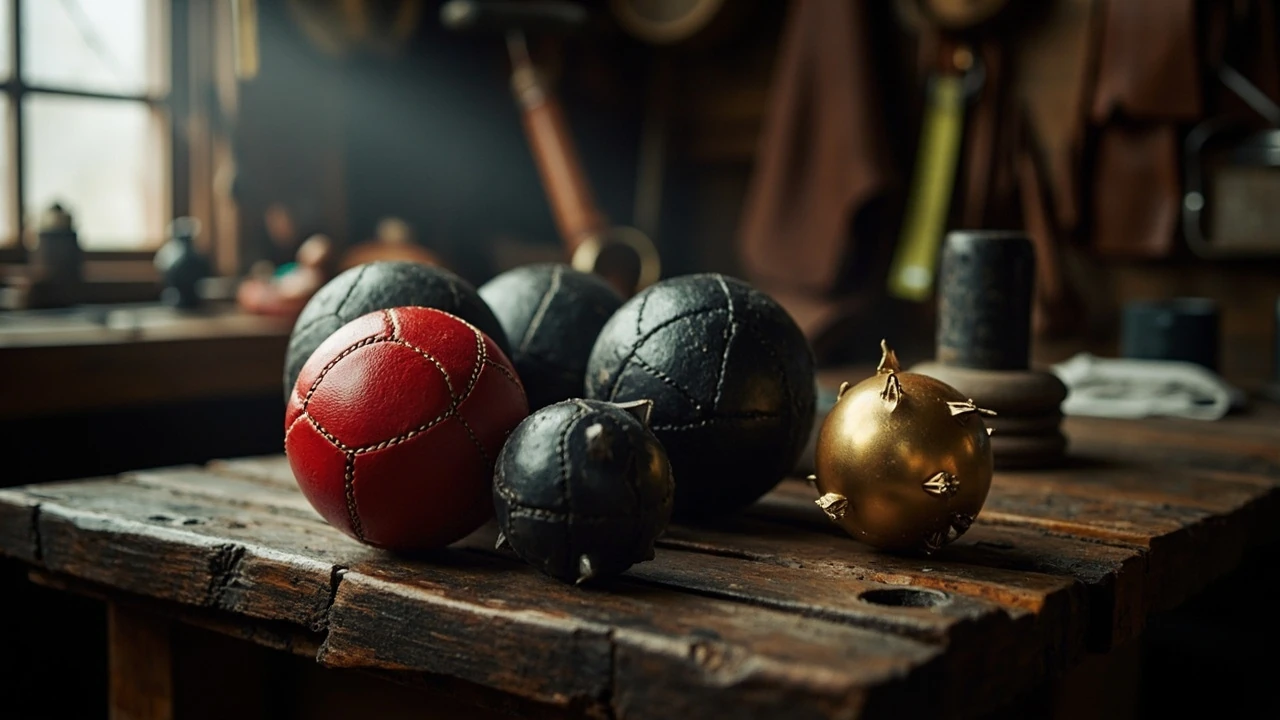
The Quaffle is the largest ball in quidditch. A standard match uses four balls: one red leather Quaffle, two black iron Bludgers, and one golden Snitch, and the Quaffle outranks the others in size by a clear margin. The two Bludgers sit in the middle of the size order, and the Golden Snitch is the smallest object on the pitch.
For readers who only need the lore answer, that paragraph is enough. For readers who also want to understand why the size order looks the way it does, and what a game developer can borrow from the same structure, the rest of the article goes deeper. The explanation below keeps the lore answer honest, then turns the four-ball design into concrete system notes for anyone building or modding a Quidditch-style prototype.
The four quidditch balls and how they rank by size
Quidditch is not built around a single ball the way association football is. It is built around four, and the size gap between them is large enough to rank them by approximate diameter rather than guess. The list below summarizes the standard ordering from largest to smallest, based on descriptions that appear across the published books and the Wizarding World rule explanations.
- Quaffle: the largest of the four balls, a red leather sphere that Chasers throw between one another to score through the three hoops.
- Bludger (two in play): the second largest balls, heavy black iron spheres that Beaters redirect at opposing players to break up play.
- Golden Snitch: the smallest ball, a winged golden sphere worth 150 points and the only object that can end a match on its own.
Players and spectators tend to identify the Quaffle first because it spends more time in human hands than any other ball. The Bludgers draw attention through sound and impact, and the Snitch draws attention through scarcity. Each of those cues is a direct consequence of the ball’s size, which is why the size order matters before any rule discussion starts.
Why the Quaffle is the largest ball in quidditch
The Quaffle is the largest because its job is possession. Chasers carry it, pass it, fake with it, and shoot it through the three hoops for ten points at a time, and the ball’s dimensions are tuned for that workflow. A larger sphere is easier to track in a crowded airspace, easier to catch cleanly with one hand during a dive, and more forgiving of small timing errors during a fast break toward the goal area.
Three design intentions sit behind that size choice, and they all map to real physics decisions in a digital prototype:
- Readability under pressure: a bigger object stays visible when multiple balls are airborne, which matters for both human players in the books and the camera in a game.
- Hand and grip ergonomics: Chasers need a sphere that fits a typical grip and stays under control when they roll, dive, or absorb a Beater hit mid-pass.
- Pass-friendly flight: a larger, slightly heavier ball behaves predictably when thrown and is harder to deflect by accident, which supports the continuous-pass nature of Chaser play.
When a developer maps those intentions into game systems, the Quaffle becomes a “primary” object with tuned drag, mass, and collider size. The other three balls are tuned around it rather than the other way around, and that order of operations is the first rule of any honest Quidditch-style prototype.
Quidditch ball sizes at a glance
The table below condenses the lore ordering, relative size, material, primary role, and the players who interact with each ball. Exact diameters and weights are not given in the published books, so the values are written as qualitative bands rather than false measurements, which keeps the table honest for readers who plan to use it as a design reference.
| Ball | Relative size | Material | Primary role | Who interacts with it |
|---|---|---|---|---|
| Quaffle | Largest | Red leather, hand-stitched | Scoring 10 points per goal | Chasers, Keepers |
| Bludger | Second largest | Black iron | Disruption and defense | Beaters |
| Golden Snitch | Smallest | Gold, winged | Ends the match, worth 150 points | Seekers |
For developers, the banded view is more useful than a fabricated number. It preserves the relative order, which is the part players notice, while leaving real tuning room for the simulation. Anyone who wants a second source for the same ranking in plain language can cross-check the size order against an existing trivia reference that covers the same answer.
How ball size shapes the rest of the match
Ball size in quidditch is not cosmetic. It is the lever that pulls the rest of the rulebook. A larger ball creates a possession layer; a smaller ball creates a catch-up mechanic. The two roles together produce the sport’s signature rhythm: long stretches of tactical Quaffle play, interrupted by Beater pressure from the Bludgers, and usually decided by a Seeker contest that the Snitch’s small size helps dramatize.
Three structural elements a developer can borrow from that design, in order of importance:
- One primary object: the biggest, easiest-to-track ball becomes the spine of the match and the player’s main interface during most rallies.
- One threat object: the second largest ball is heavier and harder to control, and it pressures players without rewarding them directly with points.
- One wildcard object: the smallest ball has the highest single-event value and the highest risk of ending play, so it needs its own catch rule.
That three-tier model maps cleanly onto many action sports and arena games outside the wizarding setting, which is one of the reasons Quidditch is a popular subject for student projects and indie prototypes.
Comparing the Quaffle, the Bludgers, and the Golden Snitch
A direct side-by-side view helps explain why the Quaffle stays at the top of the size order. The table below pairs each ball with the kind of pressure it applies, the implementation focus a developer would assign it, and the failure mode that tends to appear when that ball is mis-tuned.
| Ball | Size rank | Gameplay pressure | Implementation focus | Likely failure mode if mis-tuned |
|---|---|---|---|---|
| Quaffle | 1 (largest) | Continuous, low per-event value | Pass arc, grip affordance, hoop detection | Throws feel random and goals feel accidental |
| Bludger | 2 | Intermittent, area denial | Beater AI, target selection, recovery state | Beaters feel passive or unfairly oppressive |
| Golden Snitch | 3 (smallest) | Single event, match ending | Spawn timing, escape AI, catch resolution | Matches end too early or drag on without payoff |
The relative size order is the first thing a new player learns, and it is also the order in which a designer should tune physics. Tuning the smallest ball first tends to destabilize the rest of the match, because the Snitch’s catch resolution changes the score curve more than any other variable in the loop.
Developer angle: turning ball roles into game systems
For developers, lore accuracy is less important than a clean system model. The four-ball setup supports a useful mental model: one ball for scoring, one ball type for disruption, and one ball for dramatic closure. Each of those roles maps to a small set of concrete decisions that show up in code, audio, and UI.
- Object hierarchy: treat the Quaffle as the primary tracked actor, the Bludgers as secondary actors, and the Snitch as a state-driven trigger rather than a continuous object in the simulation.
- Camera and HUD: the largest ball deserves the most readable rendering, including a stronger silhouette, an optional motion trail, and a higher target marker priority on the minimap.
- Input mapping: Quaffle actions map to standard controller inputs such as pass, shoot, and fake. Bludger actions map to context-sensitive Beater inputs. Snitch actions are almost always the Seeker’s special move, with its own button and cooldown.
- Audio cues: larger, denser balls should sound heavier, with low-frequency thuds on impact. The Snitch should sound distinct from everything else, because players often need to hear it before they see it.
Following that structure keeps the system honest. Players will not need to know any explicit diameters to feel the size difference, because they will feel it through grip, weight, audio, and how the camera frames each ball during a rally.
Tuning ball physics without official numbers
Because the published books do not give exact diameters or masses, a developer should tune from observable behavior rather than invented statistics. The checklist below is a safer starting point than citing a “12-inch Quaffle” that no published source actually supports, and it keeps the prototype aligned with the lore’s relative order.
- Start with a Quaffle collider that is roughly 1.4 to 1.8 times the diameter of the Bludger collider and roughly 2 to 3 times the diameter of the Snitch collider in your editor units.
- Give the Quaffle enough mass to feel thrown rather than launched, even at high pass speeds, so that Chaser play still looks like throwing and not shooting.
- Keep Bludger movement heavy and slightly under control, because a perfectly accurate Bludger is less interesting than one that threatens teammates and opponents alike.
- Make the Snitch fast, evasive, and hard to grab, so that its small size is felt in the catch animation more than in the flight arc itself.
- Re-test after every change to one ball, because a single radius adjustment can shift how the camera and the AI read every other ball in play.
Those are starting values, not canon. Treat them as design hypotheses that you confirm with playtests and instrumented matches. The lore provides the size order, the simulation provides the numbers, and the gap between the two is where most of the design work actually happens.
Why the Snitch is small even though it ends the match
It is tempting to assume the most important ball should be the largest, but quidditch does the opposite on purpose. The Golden Snitch is small because smallness is part of its identity: it is hard to see at full pitch, hard to catch cleanly, and easy to lose in a crowded frame. That visual scarcity is what makes a Seeker catch feel like a moment rather than a routine event.
From a systems perspective, three trade-offs follow from the Snitch’s small size, and they all show up in real Quidditch-style prototypes:
- Visual rarity: a small object on screen reads as rare, which raises tension without extra animation work or extra camera logic.
- Input precision: catching something small demands a tighter hitbox and a more generous catch window, both of which are common in arcade-style games and easy to feel under-tuned.
- Risk asymmetry: the small ball is also the most fragile in narrative terms, so the design must protect it from being caught by accident, especially in matches with many players.
Implementing a Snitch that ends matches the way the books describe usually means a custom catch rule, a delayed spawn, and a strong escape AI rather than a generic fast enemy. Tuning the smallest ball first tends to break the score curve, so most teams end up tuning the Quaffle and Bludgers first and the Snitch last.
Common design pitfalls when recreating the four-ball setup
Quidditch games that feel wrong almost always fail in the same handful of places. The list below is drawn from the kind of feedback that shows up in playtests of Quidditch-style prototypes and similar arena sports, and each item connects back to the size order the rest of the article describes.
- Wrong score curve: if the Snitch is worth 150 points, Chaser play must be able to reach that gap on its own, or Seeker catches end matches before the rest of the loop has a chance to read.
- Bludgers as a nuisance: Beaters who only annoy a single player create a low-impact role, while Beaters who can swing momentum need smart targeting and clear recovery states.
- Snitch on rails: a Snitch that flies a fixed pattern is boring after one match, while a Snitch with adaptive escape behavior stays readable across long sessions.
- Quaffle invisibility: a primary ball that is hard to track breaks the whole possession loop, so render, audio, and HUD choices must reinforce it as the largest object on the pitch.
- Uniform ball feel: if all three balls feel the same in flight, the size order stops mattering, so mass, drag, and impact sounds need to scale with the relative size of each ball.
Each pitfall has the same underlying cause: the size order was forgotten at some point in tuning. When the Quaffle does not read as the largest ball, the entire match structure weakens and the rest of the system has to compensate.
Quick reference: what each ball does in one line
For a developer keeping notes on the side of a design document, a one-line summary is sometimes more useful than a paragraph. The list below compresses the four-ball setup into a single line per ball and can be copied straight into a design doc as the “ball contract” a prototype has to honor before the match loop is considered finished.
- Quaffle (largest): the primary scoring object, tuned for readable possession play and consistent Chaser throws.
- Bludger (second largest): the disruption object, tuned for area pressure and Beater skill expression on both teams.
- Golden Snitch (smallest): the closure object, tuned for dramatic Seeker contests and a single match-ending catch per game.
Keeping that contract visible during tuning helps a small team avoid the most common failure mode, which is adjusting one ball in isolation and accidentally shifting how the other two feel in the same match.
Translating the lore answer into a feature checklist
If you are scoping a Quidditch-inspired mode, a small feature checklist keeps the lore answer connected to production work. Each item below is something a real prototype would need before the four-ball loop feels honest, and the list is short enough to fit on a single page of a design document.
- Three distinct ball prefabs with measurable size differences in editor units, and a visible scale reference so the gap reads in screenshots.
- Two ball roles (scoring, threat) and one closure event (Snitch catch) clearly separated in code, with their own state machines and tags.
- Beater AI that targets intelligently rather than firing on a fixed timer, including a recovery state after a missed swing.
- Seeker catch state that resolves deterministically and triggers a clean match-end sequence without a soft lock or a double-catch edge case.
- Audio and HUD hierarchy that reinforces the Quaffle as the primary object, so that new players can identify it within the first ten seconds of a match.
- Instrumentation that logs the time of the first Snitch spawn, the first Beater hit, and the first Quaffle goal, since those three timestamps explain most tuning issues.
Working through that list is a faster way to validate a Quidditch design than rereading the rulebook. The lore tells you what the player should feel, the checklist tells you what you have to ship to deliver that feeling, and the size order is the thread that ties the two together.
How the size order compares to real-world ball sports
Quidditch is not the only sport where ball size carries meaning, and the comparison helps put the four-ball design in context. Association football uses one mid-sized ball, basketball uses a single larger ball with a built-in handling affordance, and baseball splits its workload between a small pitched ball and a larger batted ball. Each of those real-world setups solves the same problem quidditch solves: give the primary object a size that matches the role it plays, and let the rest of the rules scale around that choice.
Quidditch extends that pattern in two ways. First, it runs three ball roles in parallel rather than sequentially, which is closer to dodgeball or paintball than to a single-object sport. Second, it ties the smallest ball to the most valuable single event, which inverts the usual relationship between size and importance. That inversion is the part most Quidditch games struggle to recreate, and it is also the part that depends most on the size order being respected.
Notes for writers, modders, and fan-project leads
Outside of commercial development, the same size order matters for fan projects, tabletop conversions, and writing. A mod that reskins a Quidditch pitch with realistic ball sizes usually feels more faithful than a mod that reskins it with dramatic colors, because players notice the size gap before they notice the paint job. The same logic applies to a tabletop rule set, where a Snitch token that is too large undermines the closure event even when the rules around it are accurate.
For writers, the practical takeaway is that the size order is the kind of detail readers notice when it is wrong, even if they cannot name it. A passage that calls the Snitch “the size of a dinner plate” will read as off, while a passage that calls it “small enough to lose in a crowd” will read as right, and the difference is the relative size of the Quaffle behind it.
Frequently asked questions
Which ball in quidditch is the largest in the official rules?
The Quaffle is the largest ball in quidditch. It is the red leather sphere used by Chasers to score through the three hoops, and it is consistently described as bigger than the Bludgers and the Golden Snitch across the published books and supporting materials.
Why is the Quaffle bigger than the other balls?
The Quaffle is bigger because it is the primary possession and scoring object. A larger ball is easier to grip, easier to track in a crowded airspace, and easier to throw predictably between teammates, which fits the continuous-pass nature of Chaser play and the 10-points-per-goal loop.
How many balls are used in a quidditch match?
Four balls are in play during a match: one Quaffle, two Bludgers, and one Golden Snitch. The two Bludgers are identical to each other, but each Bludger is still treated as a separate object because either can be redirected independently by Beaters on either team.
Are the Bludgers the same size as the Quaffle?
No. The Bludgers are described as the second largest of the four balls, but they are still smaller than the Quaffle. That gap matters for design because the Quaffle is meant to be readable, while the Bludgers are meant to feel like threats that move faster and hit harder than the ball Chasers carry.
Which ball in quidditch is the smallest?
The Golden Snitch is the smallest ball in quidditch. It is a winged golden sphere roughly the size of a large walnut, and it is the object Seekers try to catch to end the match and add 150 points to their team’s score.
Does the size of the Quaffle affect scoring?
Indirectly, yes. The Quaffle’s size is what makes passing and shooting feel reliable, which is what allows Chasers to score consistently throughout a match. If the Quaffle were smaller and harder to control, the 10-points-per-goal loop would feel more random, and the 150-point Snitch would overpower the rest of the scoring system.
Does J.K. Rowling give exact measurements for the balls?
The published books do not give precise diameters or weights for any of the four balls. Descriptions emphasize the relative order, the materials, and the behaviors, which is why most Quidditch games tune physics from observed behavior rather than from quoted numbers.
How should a developer size a Quaffle in a game prototype?
A practical starting point is to make the Quaffle collider roughly 1.4 to 1.8 times the Bludger collider and roughly 2 to 3 times the Snitch collider in your editor units. Confirm those values in playtests rather than treating them as canon, and adjust until the Quaffle reads as the primary object and the Snitch reads as the rare object.
What happens if a Quidditch game tunes the Snitch like a normal ball?
Matches usually end too early or feel anticlimactic. The Snitch needs a slow spawn, an evasive flight model, and a tight catch rule to preserve the tension that justifies its 150-point value and its match-ending role in the broader loop.
Can a Quidditch-inspired game change the ball sizes and still feel right?
Yes, as long as the relative order is preserved. The lore answer to which ball in quidditch is the largest is the Quaffle, and that hierarchy is the part players expect. Exact diameters are flexible, but the size order between the Quaffle, the Bludgers, and the Snitch is part of how the sport is read at a glance.


Leave a Reply