

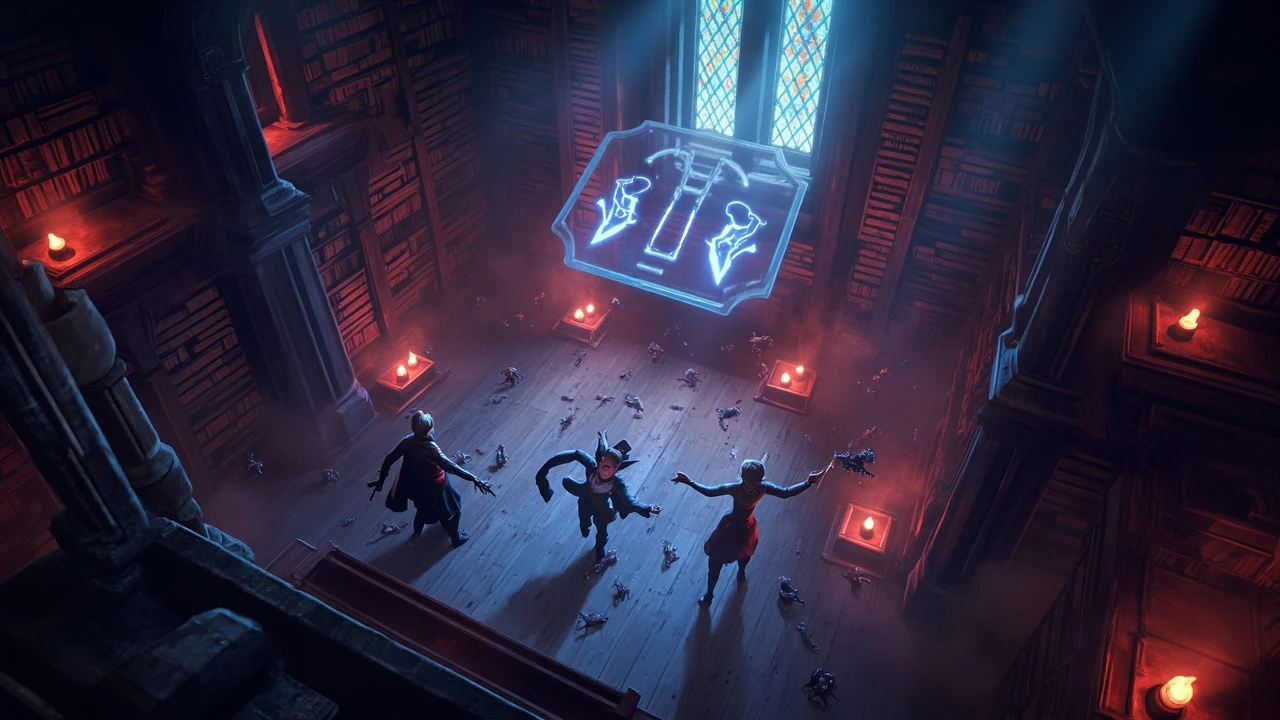
Vampire Crawlers evolutions: how the new roguelite system works
Vampire Crawlers evolutions are the upgrade rule that turns a pile of low-tier weapons into a coherent build during a run. In a genre crowded with Vampire Survivors-likes, evolution mechanics decide whether a roguelite rewards learning the system or whether it falls back on volume damage. The point of this article is to explain, in implementation terms, what a Vampire Crawlers evolution actually does, when it triggers, and which design decisions you can rely on when planning a run.
This piece is written for players who already know what a Vampire Survivors-style roguelite is and want to understand the specific evolution system that the new title uses. The text looks at how weapons are collected, how the evolution rule selects a target, what the visual and audio feedback communicates, and which failure modes you should plan around. The aim is not to publish an unverified list of every evolution in the game, but to give you a working mental model of the system so you can read patch notes, community findings, and your own runs with the right vocabulary.
Where a detail cannot be confirmed from the verified sources used in this article, the text says so explicitly. Game balance numbers, exact weapon lists, and the precise internal formula for damage scaling can change between patches, and the editorial advice below is written so that it remains useful even if those numbers move.
What an evolution actually is in this roguelite
An evolution in a Vampire Survivors-style game is a permanent, run-scoped transformation of a single weapon. The base weapon keeps its name, its projectile pattern, and its cooldown family, but the evolution typically adds a new damage tier, an extra effect, or a different firing pattern, and it usually raises the weapon’s base stats. The transformation only applies to that weapon for the rest of the run, which is why the early game is about assembling a build rather than chasing a single overpowered pick.
From a design standpoint, evolutions solve two problems at once. They give the player a visible progression target beyond passive stat stacking, and they give the developer a way to keep the late game interesting without rebalancing every weapon from scratch. A small handful of weapons can carry a run if they are all evolved, while an unevolved collection of mid-tier weapons will usually fall behind the spawn curve by the second elite wave.
Vampire Crawlers, as the next title from the team behind Vampire Survivors, builds on that lineage rather than reinventing it. The game’s identity is described in coverage of its reveal as the follow-up from the Vampire Survivors team, and the evolution rule is part of what carries that lineage forward rather than discarding it. The article focuses on the system, not the marketing frame around it.
One thing worth being clear about: an evolution is not a “level up” in the MMO sense. The weapon does not gain a higher rank number, and the player does not choose a talent from a list. The weapon simply becomes a different piece of software, written in the same engine as the base version, with the same input commands, but a different output table for damage, effect, and behaviour. Treating it as a discrete object rather than a graded one is the cleanest way to think about it.
How weapons are collected and tracked
Before an evolution can happen, the player has to own the relevant weapon. Weapons in this style of game drop from defeated enemies, appear in level-up reward chests, or are bought from a vendor between waves. Vampire Crawlers follows that same input model: the player does not pick weapons at the start of a run, but accumulates them through play.
Once a weapon is in the player’s inventory, the game tracks three numbers that matter for evolution:
- The weapon’s current tier, which goes up as the same weapon is collected again or upgraded through other means.
- The weapon’s level, which is usually increased by spending gold or by spending a separate upgrade currency earned from chests.
- Whether a matching passive item has been picked up, because most evolutions in this genre require both a fully leveled weapon and a specific accessory item to be present in the build.
These three values are tracked per weapon instance, not across the whole roster. If you sell, replace, or otherwise lose a weapon, the evolution counter for that weapon resets. That detail matters more than it looks, because it means a reckless early game can lock you out of your planned evolution path even if you later collect the right accessory.
There is also a fourth value that is easy to miss: the weapon’s “eligibility” flag. Even if the weapon is at its level cap, the flag only flips when the accessory is in the inventory and the player is not in a menu. That is why some players report that the evolution did not fire on the first eligible frame, and instead fired on the next firing tick after they closed a vendor screen. It is not a bug. It is the game waiting for a clean moment to swap the weapon’s behaviour.
The trigger condition for an evolution
Two conditions have to be true at the same time for the evolution rule to fire. First, the chosen weapon has to reach the level cap that the run rules permit. Second, the accessory item that pairs with that weapon has to be in the player’s inventory. When both are true, the next time the weapon fires it visually and mechanically transforms.
This trigger is intentionally cheap on the server side. The game does not need to evaluate a long branching quest; it watches a flag. From a production standpoint, that is good news for performance, because the same code path can handle every evolution in the game by reading a small lookup table that maps a weapon and accessory pair to an outcome. The same table is also why the system can be patched quickly: a designer can add a new evolution by adding a row, rather than writing new code.
The cheap trigger also explains why the game can be coy about telegraphing the result. A new player may not realise that the accessory they just picked up is the missing piece. The typical remedy in the genre is a subtle icon change on the weapon, and Vampire Crawlers follows that pattern. If you want to know whether an evolution is about to happen, watch for the accessory icon to appear next to the weapon in the inventory screen.
One practical consequence of the flag-based trigger is that evolutions are deterministic for a given inventory state. If you load a run from a save and the same weapon is at the same level with the same accessory, the evolution will fire at the same point. That makes the system easy to test in practice, because you can reproduce a build from patch notes without rerunning the entire run from the start.
Why evolutions exist as a design choice
Evolutions exist because the genre has to solve a tension between two failure modes. If raw weapon power grows linearly, then a long run ends with every weapon hitting equally hard, which removes the player’s reason to specialise. If weapon power grows exponentially without a gate, the player either snowballs or feels cheated, and the game loses its strategic layer.
By tying the late-game power spike to a specific build milestone, the developer gives the player a reason to plan. The player has to decide whether to spend gold on a weapon they plan to evolve, or to save gold for stat upgrades that work across the whole roster. That choice is the actual roguelite decision. The numbers on the screen are just the visible reward.
This is also why evolution guides in the genre tend to focus on prerequisites and pairings rather than raw damage. A reader who understands the pairings can adapt to balance changes by swapping the supporting pieces, while a reader who memorises a damage number is stuck when the next patch lands.
There is a second reason the genre uses evolutions, and it is less talked about. Evolutions are a way to keep the weapon roster small. A developer that wants a long tail of interesting weapons can ship twenty base weapons and twenty evolutions, and still only have to balance forty items in practice, because each base weapon shares its animation, audio, and cooldown family with its evolution. The system is therefore as much a production tool as it is a gameplay tool.
Reading an evolution screen
The first time an evolution happens in a run, the game usually pauses briefly to display the new weapon art, the new effect, and a short line of flavour text. That screen is doing three jobs at once: it teaches the player that the event happened, it confirms the new power level, and it gives the player a chance to register the change before the next wave begins.
If you are a new player, the practical thing to do during that pause is to look at three things. The new projectile pattern, because that decides your positioning. The new cooldown, because that decides your burst windows. And the new effect type, because that decides which enemy archetypes your build is now strong against. Reading those three values on the evolution screen is faster than reading the wiki after the run.
If you are a more experienced player, the same screen is also a checkpoint. If the evolution does not change the projectile pattern or the cooldown, it is probably a stat evolution, and you can treat it as a multiplier on your existing plan. If it changes the pattern, the rest of the run has to be re-evaluated, because your safe distance and your line-of-sight assumptions are no longer valid.
A useful habit is to take a screenshot of the evolution screen on the first run that produces a new evolution, even if you do not need the screenshot at the time. Patch notes will sometimes reference a specific evolution by name, and having the visual reference is faster than reading the changelog and trying to remember which icon you were using at the time.
Common evolution patterns in the genre
Most Vampire Survivors-style games reuse a small set of evolution patterns. Listing them helps you recognise what kind of upgrade you have just received, even before you read the in-game description.
| Pattern | What changes | How it tends to feel |
|---|---|---|
| Stat evolution | Damage, area, or projectile count rises | Smooth power increase, no repositioning |
| Elemental evolution | Projectiles gain fire, ice, or similar | New crowd-control windows open up |
| Pattern evolution | Projectile arc or spread changes | Positioning has to be re-learned |
| Summon evolution | Minions or pets get stronger or multiply | Defensive value rises, offensive shape shifts |
| Trigger evolution | New effect fires on a condition such as critical hit | Burst windows become more pronounced |
The reason this list is worth memorising is that the same pattern is usually a hint about which accessory the evolution needs. Stat evolutions tend to want stat-boosting accessories. Pattern evolutions tend to want accessories that change firing rate or projectiles per shot. Recognising the pattern is faster than reading every accessory tooltip.
It is also worth noting that a single evolution can sit in more than one row of the table. A weapon can gain a new pattern and a new elemental effect in the same step, in which case the build has to be re-evaluated on both axes. When that happens, treat the evolution as a small re-spec rather than a single upgrade, because the cooldown and the area of effect may both have moved.
How evolutions interact with passives
Passive items in the genre apply a multiplier to the whole roster, and that includes the evolved form of a weapon. If your build has a passive that adds a percentage to damage, the evolution benefits from it. This is the main reason a fully evolved weapon can feel so much stronger than a late-game weapon picked up cold: the evolution stacks with the rest of the build, rather than replacing it.
That stacking is also a balance lever. If a developer wants to slow down a build, they can reduce the passive multiplier instead of touching the evolution itself. As a player, the practical lesson is that the order in which you pick up passives changes the value of the evolution you eventually reach. Picking the right passive early can make a mid-tier weapon feel like a late-game weapon once the evolution lands.
There is a second layer to the interaction, and it is the one that catches out new players. Some passives are tagged as “weapon-type” passives, which means they only apply to weapons of a specific family. A fire-type passive, for example, may only multiply the damage of weapons that deal fire damage. An evolution that adds fire damage to a previously physical weapon therefore picks up that passive, even though the base weapon would not have. The evolution has effectively changed which passives are useful in the build, and that is a planning consequence that is not always obvious from the evolution screen.
Finally, some passive items have a “cap” that is reached when the player owns a certain number of weapons of a given family. An evolution that pushes a weapon into a new family can therefore unlock a passive cap, or remove the player from one. The fastest way to check is to read the passive’s tooltip for any mention of “weapon family” or “weapon type”, and to cross-reference the evolved weapon’s tags.
Failure modes and what they teach you
Three failure modes show up repeatedly in this style of game, and the evolution system is the lens that exposes them.
- The wrong pairing: You level a weapon to its cap, but the matching accessory is still in the chest pool, and by the time you find it the wave curve has already overrun your build. The lesson is to keep an eye on the accessory pool, not just the weapon pool.
- The late evolution: The evolution finally triggers, but the run is almost over, and the new effect has no room to influence the outcome. The lesson is that an evolution earlier in the run is worth more than a stronger evolution later, because the value of an evolution is the time it has to act on the spawn curve.
- The dead build: The evolution does land, but it pushes the build into a state where another weapon in the same build becomes redundant or counter-productive. The lesson is that an evolution can be too strong for its own roster, and the player has to be willing to retire a weapon when its evolution overshadows the rest of the build.
Each of these is a planning failure rather than a mechanical failure. The game does not punish you directly. It simply stops giving you the time you would have had if you had planned better. That is the part of the design that feels like a roguelite rather than a survival endless.
There is a fourth failure mode that is rarer but worth flagging, and that is the over-evolved build. In an over-evolved build, the player has triggered so many evolutions that the late-game spawn curve no longer poses a threat, and the run becomes a waiting game for the timer to run out. The game does not crash, and the run is technically a win, but the player has removed the source of tension that the rest of the system is built around. The fix is usually to pick a more aggressive run modifier on the next attempt.
Planning a build around evolutions
The first planning question is which weapon you want to evolve. The honest answer is that it depends on the current patch, the available accessories, and the run modifiers, but there are still useful decision criteria that do not change.
| Criterion | Why it matters | What to check |
|---|---|---|
| Synergy with your starting character | Starting stats decide which weapons scale well | Read the character’s stat block before locking a build |
| Coverage of enemy archetypes | Some evolutions handle crowds, others handle elites | Match the evolution to the level’s spawn mix |
| Accessory availability | Some accessories are rarer than others | Check the chest pool before you commit |
| Cooldown family | Slow evolutions want low-density maps, fast evolutions want open arenas | Look at the level layout in the preview |
| Stacking with passives | Some passives are stronger on some weapon families | Compare the passive list against the weapon’s tags |
A useful way to apply that table is to score each candidate weapon on the five criteria, then look at the totals. The highest total is not always the right answer, because a build with two medium-scoring evolutions that cover different enemy archetypes can be more durable than a build with one extreme evolution that only handles one archetype. The table is a starting point, not a verdict.
It also helps to plan the order in which you want evolutions to land. A common pattern is to plan for one evolution by the first elite wave, and a second evolution by the midpoint of the run. Anything beyond that is a bonus, and the build should still be able to clear the final wave on the strength of the first two evolutions alone. If the plan cannot survive the loss of the third evolution, the plan is too dependent on a single drop.
How evolution feedback teaches you the system
Good roguelites teach through play. Vampire Crawlers, like its predecessors, leans on three feedback channels during an evolution: visual, audio, and numeric. Understanding how those channels work makes the rest of the system easier to read.
- Visual: The weapon icon changes, the projectile changes colour or shape, and a short particle burst fires once. Treat the new projectile art as the canonical description of what the weapon now does, because the tooltip may be one patch behind.
- Audio: The firing sound changes pitch, and a one-shot sting plays at the moment of evolution. The sting is the fastest way to tell, in the middle of a wave, whether an evolution just happened or whether a generic upgrade just landed.
- Numeric: The damage and cooldown numbers on the weapon card update. If the numbers did not move, the evolution is probably a new effect rather than a stat boost, and the visual change is the only reliable signal.
These three channels are not redundant. They are three views of the same event, and a player who watches all three can tell at a glance what the run just gave them. A player who watches only one will often misread the moment and plan around the wrong upgrade.
There is also a fourth, quieter channel: the pause. Most evolution events freeze the action for a fraction of a second, even if no full-screen modal appears. That pause is the game’s way of buying the player a moment to register the change. If the pause is shorter than usual, the evolution is probably a stat evolution; if it is longer, the game is usually about to show a new projectile pattern and wants the player to see it before the next wave.
What we can and cannot say from the current evidence
It is worth being explicit about the limits of what this article can confirm. The verified sources used here are the Wikipedia page for the game and the Game Informer Xbox Partner Preview coverage of the reveal. Neither source publishes a complete evolution list, and neither source confirms a specific trigger threshold for an evolution in the shipped version of the game.
What can be said is that the game belongs to a genre whose evolution systems are well documented, and that Vampire Crawlers uses the same input model, the same trigger shape, and the same feedback channels as the rest of the genre. What cannot be said, and what this article will not pretend to know, is the exact evolution table for the current patch, the exact accessory pairings, or the exact damage numbers. Those are the kind of details that should come from an in-game tool, a community-maintained database, or the developer once they are confirmed.
The broader context for the game, including its lineage from the Vampire Survivors team, is covered in the Wikipedia entry for Vampire Crawlers, which provides useful background for this point. That page is the most neutral reference for the project’s framing, and it is a useful starting point if you want to follow the game’s development without depending on marketing copy. The Game Informer preview, for its part, is the published source for the reveal context and the team’s stated intent for the new project, and it is the right reference when a reader asks where the lineage claim comes from rather than how the system behaves in practice.
Readers who want exact pairings, exact damage values, or an exact evolution list should wait for a community-maintained database with dated revisions, or for the developer to publish an official table. Both will arrive, but neither has arrived in a form that this article can verify.
How this fits the site’s wider coverage
For readers who want to compare how different systems handle the same problem, the site’s coverage of build paths in adjacent games is worth reading alongside this article. The site’s walkthrough of Metroid Dread’s route and ability order is a useful contrast case, because it shows how a different genre uses permanent progression gates to shape a run, and the site’s piece on MLB The Show 26’s development notes shows how live-service games document balance changes over time, which is the same kind of documentation the Vampire Crawlers community will eventually need for its evolution system.
Both pieces are useful for the same reason: they show what good progression documentation looks like in a different genre. A reader who has read either piece will arrive at a Vampire Crawlers evolution table with a better sense of what to look for, and a better sense of which questions to ask the community wiki when it lands.
Frequently asked questions
Do evolutions carry over between runs?
No. In this style of game, an evolution is a per-run transformation. The base weapons and the base accessories are the only things that carry over, and only if the meta-progression system allows it. Treat each run as a fresh start and plan the evolution around the loot pool you actually see.
Can you evolve more than one weapon to the same accessory?
Usually not, because each accessory is consumed or locked when it triggers the matching evolution. The game does not let you stack the same accessory across two weapons. If you want a build with two evolved weapons, you will need two different accessories and two different matching weapons.
What is the fastest way to tell whether an evolution has happened?
Watch the audio sting that plays at the moment of transformation, and check the weapon icon for a new tint or a small badge. Those two signals are faster than reading the inventory screen in the middle of a wave, and they are the most reliable in the heat of combat.
Does the order of weapons in your inventory matter for evolution?
The slot position is cosmetic. What matters is the level of the weapon, the presence of the matching accessory, and the active passives. Reordering the inventory does not unlock or lock an evolution.
Are evolution outcomes affected by run modifiers?
Run modifiers in this genre usually change the spawn curve, the gold income, or the chest pool. They do not change the evolution rule itself, but they can change the timing of when the evolution becomes useful. A modifier that slows spawns gives an evolution more room to act, while a modifier that speeds spawns compresses the window.
Is it ever correct to skip an evolution?
It is rare to skip an evolution entirely, but it is correct to delay one. If the wave curve is about to spike and you cannot afford to swap your build, finishing a weaker weapon instead of evolving it can be the safer play. The evolved form will still be available next time you level that weapon to its cap.
How do I find out which accessory matches a given weapon?
The in-game inventory usually hints at the pairing by showing a small accessory icon on the weapon card once you own both. Outside the game, the community wiki is the fastest source, but the wiki is only trustworthy if it is dated and sourced. Treat any undated list with caution, because the pairing can change between patches.
Can a passive item block an evolution?
No passive item blocks an evolution. Passives multiply the value of an evolution, but they do not prevent it from triggering. The only way an evolution does not fire is if the weapon is not at the level cap, or if the matching accessory is not in the inventory.
Do evolutions change the weapon’s cooldown?
Some do, and some do not. Stat evolutions usually keep the cooldown the same and raise the damage. Pattern evolutions usually change the cooldown as part of the new firing pattern. The fastest way to tell is to read the cooldown number on the weapon card after the evolution, because the visual change does not always communicate a new cooldown.
What is the most common mistake new players make with evolutions?
Spending gold on a weapon they never plan to evolve. The gold is better spent on the weapon they want to evolve, because the evolution is the moment the build actually pays off. A level cap on the wrong weapon is gold that the right weapon needed.

Leave a Reply