

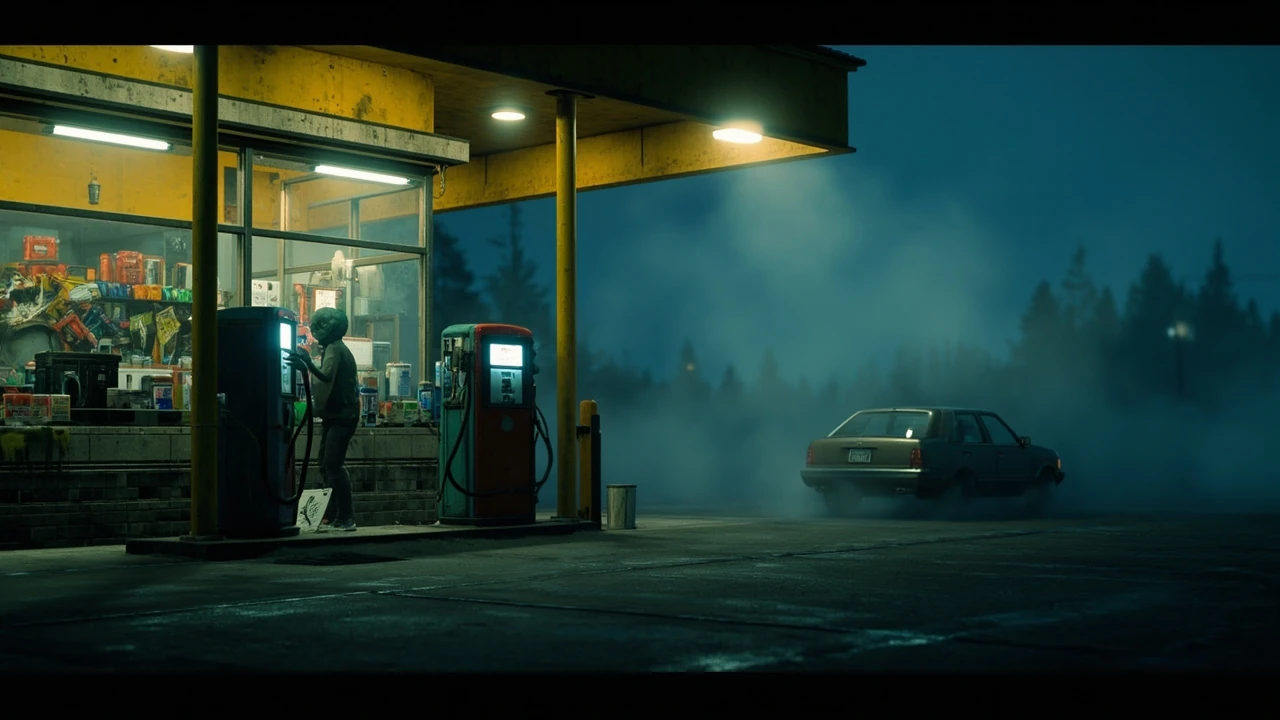
Roadside Research: what the alien gas station sim actually is
Roadside Research is an Early Access co-op simulation in which players run a rural gas station while secretly harvesting data on human customers for an alien research program. The Steam listing frames it as a 1-4 player experience built around two overlapping loops. By day, players stock shelves, refuel cars, and sell food to travelers. By night, they scan, test, and gather information on customers without breaking cover, while a suspicion meter keeps the whole operation in check. The studio’s published summary puts the tension in one line: the player has to “blend in” as a normal employee while upgrading alien technology that processes stolen data.
this page reads Roadside Research as a design problem rather than a marketing profile. It looks at how the listed systems are described, what a co-op design of this kind normally has to solve, what Early Access players can actually validate right now, and which questions stay open until the studio ships further updates. The short version is in the next paragraph; the rest of the article is for developers, designers, and technically curious players who want to understand the mechanics under the hood.
The most useful single observation about Roadside Research is that it is a layered simulation, not a single-loop tycoon. The daytime work uses familiar service-station verbs (restock, refuel, serve) while the night phase adds a parallel management layer around alien equipment, research upgrades, and the suspicion meter. Because both layers share one building and the same human traffic, the design’s real problem is scheduling: which station task, which research task, and which upgrade competes for the same limited closing-hour budget.
Premise and setting as a design choice
The premise in Roadside Research is a thin disguise sketch rather than a scripted narrative. Aliens have landed on Earth and chosen to run a gas station as cover for a data-collection mission. The setting is rural, the customers are ordinary travelers, and the only stated threat is a government inspection triggered by high suspicion. That kind of premise is a deliberate choice: it gives the designers a small, controlled location, a steady stream of varied customers, and a justification for both loops without a heavy story budget.
For a developer reading the store page, the interesting question is what the premise unlocks. A gas station produces a predictable rhythm of arrivals, a fixed set of actions per customer, and a small inventory that can be restocked in discrete steps. Those properties are useful because they are easy to tune, easy to test in co-op, and easy to teach in a short tutorial. A rural location also keeps the art and audio budget low, which matters for a small Early Access team.
The “alien cover” framing does more work than a joke suggests. It supplies a reason for the suspicion meter, an excuse for the player character to behave awkwardly, and a hook for comedy in co-op. It also explains why research and service are competing for attention instead of living in separate menus. The premise justifies the system, and the system makes the premise feel like a mechanic rather than a tagline. Most of the design risk in Roadside Research lives in the relationship between the two loops, not in either loop on its own.
Core gameplay loop: daytime service
The daytime loop in Roadside Research is a small but complete service simulation. Players restock shelves, order inventory, refuel customers, and sell food. The Steam description lists those tasks explicitly and implies a basic cash economy, because goods are exchanged for money the station can reinvest. For a co-op game, the loop has the right granularity: each action is short enough to hand off to a different player, but each action also has a visible effect on the station.
The first design question is how forgiving the daytime loop has to be. A gas station is a throughput system: cars arrive, players serve them, and the station either keeps up or it does not. If customers queue too long, the suspicion meter will rise, which means the daytime loop is also the player’s defense against the failure state. That coupling is useful because the developers do not have to invent a separate alarm system; the meter is the alarm, and the queue is the trigger.
The second question is how inventory and ordering are paced. The store page mentions ordering wares for the shop, which suggests a simple wholesale layer with at least one or two input goods. For an Early Access build, the most likely pattern is a fixed set of recipes or stock lists, with prices and restock times tuned by hand. A small number of SKUs keeps the UI readable in co-op and keeps the simulation stable across patches. A larger number of SKUs gives the developers more knobs to turn, but it also makes the game harder to learn and harder to balance.
Core gameplay loop: night research
The night loop is where Roadside Research separates itself from a pure service sim. The Steam description says that during closing hours, players can upgrade the station and process data through alien technology. The framing is that the alien tech is hidden while the station upgrades are visible, and the suspicion meter gates the visible side of the work. For a developer, the interesting move is that night and day are not just two halves of a clock; they are two resource pools that share the same building.
In the most common version of this pattern, the night phase uses a separate currency, a separate upgrade tree, and a separate set of decisions. Roadside Research’s published summary hints at that structure. Players are told to “balance between two missions,” and the descriptions of the alien tech and the station upgrades run in parallel rather than overlapping. That is a strong design hint, because it suggests the developers have decided that the two loops should not feed each other directly. If they did, the daytime loop would become a grind for the night loop, and the game would lose the choice between honest service and covert research.
The suspicion meter is the bridge between the two loops. A high meter triggers a government visit, which is presumably a disruptive event rather than a permanent failure. In design terms, the meter is a soft timer: it forces the player to spend some of their attention on visible normality, and it gives the alien loop a constraint without making the alien loop the only thing that matters. The main risk is that the meter either becomes a non-event (because it never trips) or a hard fail (because it always trips). Early access is exactly the time to calibrate that range.
Co-op design: how a 1-4 player gas station is supposed to work
The store page advertises “chaotic solo or co-op fun” and supports 1-4 players. A co-op gas-station simulation has a few well-known design pressures. The first is role overlap: if every player can do every task, the late game becomes a fight for the same checkout counter, and the early game has nothing for the second player to do. The second is role lock-in: if each player has a fixed role, the second player has to wait for the first player to die, quit, or hand over the role. The third is information asymmetry: in a game about hiding alien research from humans, not every player should see every signal.
For Roadside Research, the published description is consistent with shared-action co-op rather than role-locked co-op. The verbs (restock, refuel, serve, scan, research) are all listed as things the player can do, and the description does not assign them to specific characters. That implies a system in which any player can pick up any task, and the team wins or loses based on how the players divide the work. The interesting design move is the suspicion meter: in co-op, one player being clumsy can raise the meter for the whole team, which is a strong reason to stay together rather than to split up.
Voice chat, proximity, or simple sign language will matter more than usual in this game, because the suspicion meter creates a reason to coordinate without an explicit communication UI. For developers, that is a real constraint. A clean co-op design for Roadside Research would not require a fully featured chat system, but it would benefit from emotes, quick callouts, and a way to point at the right shelf or the right car. A game that is too quiet in co-op will be played mostly solo, and a game that is too loud will be played only with friends.
Progression systems: station upgrades and alien tech
Roadside Research describes two parallel upgrade paths. The station itself can be upgraded inside and outside to attract more customers, and the alien tech can be upgraded to process data more efficiently. The two paths share a goal (the player’s overall objective) but are separated in resource, because the Steam description treats them as two distinct investment tracks.
The most likely design pattern is a small binary or ternary tree for each track, with two or three tiers per branch. That is a common Early Access choice, because it lets the developers ship a small tree, watch how players spend their currency, and then expand the tree in a later patch. The risk of a binary tree is that it becomes readable on a wiki after a few hours and the player has no reason to discover anything new. The risk of a wider tree is that it is hard to balance in early access, because the developers have not yet seen the steady-state economy.
The published summary also mentions a “disguise” that the player can customize. The store page says the player can “draw a very normal human expression” on the disguise. That line is a strong design signal: the customization is part of the comedy, and it is also a low-cost way to add replay value. A face that the player can redraw is a low-art asset, a high-laugh feature, and a system that the developers can keep tweaking without breaking the rest of the game.
Failure and recovery: the suspicion meter and the government visit
The suspicion meter is the only named failure condition in the Steam description, and the only named consequence is a visit from government officials. That phrasing is deliberately soft, because it leaves the developers room to decide whether the visit is a scripted event, a randomized inspection, or a wave-based encounter. For an Early Access game, the most common choice is a randomized inspection that arrives after the meter crosses a threshold and that interrupts the current shift with a small puzzle or a timed event.
Recovery from a government visit is a separate design question. In the most common version of this pattern, a visit costs the player some research progress or some in-game cash but does not end the run. That choice keeps the game from becoming a roguelike, which fits a service sim. It also means the suspicion meter is a real cost rather than a fail screen, which gives it more design weight over a long session.
For developers tuning this part, the most useful signal is how often the meter trips in normal play. If the meter never trips, the cover identity is meaningless. If the meter trips every shift, the game becomes a survival game. The sweet spot is somewhere where the player notices the meter, manages it, and only occasionally lets it slip. Early access telemetry on how often the meter crosses each threshold is the cheapest way to find that point, and the studio can act on it without rewriting the simulation.
Audio, art, and the rural gas-station mood
The store page does not promise a specific art style, but the verbs and the setting suggest a small, readable scene rather than a large open world. A rural gas station is a tight level: one forecourt, one shop interior, one back room, one storage area. That footprint is friendly to small teams, because each space can be dressed with a small set of props and reused for many hours of play. It is also friendly to optimization, because the render budget is bounded by the size of the level.
Audio carries more weight than usual in this setting, because the gas station is full of small, repeatable sounds. The door chime, the fuel pump, the cash register, the radio, and the coffee machine are all part of the daytime loop. Each one of those sounds is a piece of feedback, and each one is also a way for the game to signal something to a co-op partner who is in the back room. A well-tuned audio mix turns the gas station into a soundscape rather than a stack of menus, which is what the developers seem to be aiming for.
For an Early Access title, the most useful art and audio targets are the assets that the player sees and hears every minute. The forecourt, the shop counter, the night-phase research console, and the disguise are all candidates for the highest-polish slot. Anything that the player only sees once can stay rough for early access, and the developers can use the early-access period to find out which assets the players actually use.
What Early Access actually means for this game
Roadside Research is listed as Early Access on Steam, which has specific implications for both the developers and the players. The Steam description explicitly notes that games in Early Access “are not complete and may or may not change further.” It also links Roadside Research to another game, Retro Rewind, in a two-item bundle, which suggests the studio is using the bundle as a way to invite players into both projects at once.
For a developer evaluating an Early Access build, the checklist is fairly standard. Are the core loops present, even if the content is thin? Is the game stable for a 1-4 player session of an hour or more? Is the balance honest, even if it is not final? Is the studio answering community questions and shipping patches on a visible cadence? The Steam listing does not promise any of those things explicitly, but they are the signals that determine whether Early Access is healthy.
For a player who is considering buying in, the useful questions are more specific. How long is a normal session? Does the game work well in solo, or only in co-op? Are the two loops actually different, or is one of them filler? How is save data handled between sessions? None of those questions are answered by the store page, which is normal for an Early Access listing, and they are exactly the questions that early-access players can answer for each other.
Comparable games and what they tell us about the design space
Roadside Research sits in a small but well-known design space. Co-op service simulations with a hidden second layer have been explored in several indie hits, and the published description of Roadside Research maps onto the same pattern. Comparing it to those games is a useful exercise, because it shows which design choices are normal and which ones are unusual.
| Comparable title | Primary loop | Hidden or secondary loop | What Roadside Research can learn from it |
|---|---|---|---|
| Generic co-op service sim (e.g. a restaurant or shop sim) | Daytime customer service, inventory, cash | Often none, or a small management layer after hours | The hidden research loop is the differentiator, not the service loop itself |
| Co-op deception game (e.g. a “two sides” party sim) | Public cooperation on a shared task | Private goal that competes with the public task | The suspicion meter is a strong design choice for the alien cover story |
| Single-player tycoon with a research tree | Long-form resource management | Tech tree as the only progression | Splitting progression into two trees avoids the “one tree to rule them all” problem |
| Co-op survival or horror with suspicion states | Resource gathering under threat | Stealth, evasion, and a low-visibility state | A government visit as a soft timer is more friendly to a service sim than a hard fail |
The pattern in the table is consistent. The service loop is the part that is easy to copy, because every gas station in real life has the same verbs. The interesting part of Roadside Research is the alien research loop, the suspicion meter, and the choice of how the two loops spend the same hours of the in-game day. If those three systems land, the game has a reason to exist. If they do not, the game is just a co-op gas-station tycoon with a costume.
Decisions a developer should think about before playing or building something similar
A short, ordered list is the right format for a pre-production checklist. The list below is the kind of thing a small team should agree on before the first vertical slice, and it is also useful for a curious player who wants to know what to look for in a public build.
- Decide whether the service loop and the research loop share a currency. Sharing a currency makes the game easier to balance but harder to keep interesting, because one loop will always be more efficient than the other.
- Decide whether the suspicion meter is a state machine with named levels (low, medium, high, critical) or a continuous bar. Named levels are easier to communicate to the player; a continuous bar gives more tuning space.
- Decide how a government visit is generated. The cleanest pattern is a probability check at the end of each shift, scaled by the meter’s final value.
- Decide what the night-phase upgrade tree actually gates. A short tree with a few clear branches is more honest in Early Access than a long tree with placeholder nodes.
- Decide how save data is structured. A small simulation of this type can be saved on shift end, on day end, or only on run end, and each choice has a different feel.
- Decide which co-op actions are interruptible. A refuel action that cannot be interrupted is fair in solo and frustrating in co-op; an interruptible action is the opposite.
- Decide which props are interactable. The cleanest version of the game is one in which every interactable prop has a clear affordance, and every non-interactable prop is clearly decorative.
Roadside Research systems at a glance
| System | Daytime behavior | Night behavior | Open design question |
|---|---|---|---|
| Service tasks (restock, refuel, serve) | Drives throughput and cash income | Not active; replaced by upgrade actions | How many SKUs before the UI stops being readable in co-op? |
| Suspicion meter | Rises with visible alien behavior; falls with normal service | Read-only; gates future risk | What is the trip threshold, and how punishing is a government visit? |
| Station upgrades | Visible; affects customer flow and shop layout | Purchased with daytime cash | Are upgrades cosmetic, functional, or both? |
| Alien tech upgrades | Hidden; tools used to scan and test customers | Purchased with research currency | Does research currency come from scans, from cash, or from both? |
| Disguise customization | Player draws a face on the disguise | Customization persists between shifts | Is the disguise purely cosmetic, or does it affect suspicion? |
| Government visit | Rare event triggered by a high meter | Cannot occur during night phase | Is the visit a puzzle, a timer, or a soft fail with a cost? |
That table is a working map of the design as described, not a prediction of the final build. Each row is a question the studio can answer in patch notes, and each row is also a question a player can answer by playing a few sessions.
Validation and instrumentation: what to measure in Early Access
For a small studio, the cheapest way to find out whether the design works is to instrument the Early Access build and watch the data. The list below is the minimum set of signals that will tell the developers whether the design is in the right neighborhood. None of these signals require a large telemetry stack; they can be written as simple counters that ship with the build.
- Counter for how many customers were served per shift, and how many left the queue without service.
- Counter for the suspicion meter value at the end of each shift, and a histogram over many sessions.
- Counter for the number of government visits per session, and the average loss from each visit.
- Counter for how players split their time between the service loop and the research loop, broken down by day and by night.
- Counter for how often a research upgrade is purchased, and which branches are most popular.
- Counter for session length, in minutes, for solo and co-op, so the developers can see whether co-op is actually lengthening play.
- Counter for the most common cause of session end (player quit, game over, natural close of day, idle), so the developers can see where the game is losing people.
Once those counters are in place, the studio can ask the simple questions: is the suspicion meter firing too often, is the research loop too rewarding, is co-op making the game more or less fun than solo. Those questions are answerable with the counters above, and the answers will tell the developers what to ship in the next patch.
Risks and open questions for the Early Access period
Every Early Access design has a small set of risks, and the design in Roadside Research has a few that are easy to name. The list below is not a complaint about the game; it is a description of the design questions that a careful developer would want to see answered in the patch notes.
- Whether the two upgrade trees stay balanced, or whether one tree is so much better that the other becomes filler.
- Whether the suspicion meter is a real signal or a decorative bar, and how often it actually trips in normal play.
- Whether solo and co-op feel meaningfully different, or whether the game is only really fun in a full four-player session.
- Whether the disguise customization is a real system with effects on suspicion, or a pure cosmetic layer.
- Whether the night-phase research loop has a long-term goal that the player can work toward, or whether it is a series of disconnected upgrades.
- Whether the government visit is a structured event with a clear solution, or a soft fail that punishes the player without giving them anything to do.
- Whether the in-game day is long enough to do meaningful work in both loops, or whether the player is forced to pick one and skip the other.
None of these questions are answerable from the store page, and that is normal for an Early Access listing. The early-access period is exactly the time to answer them, and the developers will learn the most by watching how players actually play, not by reading how the players say they would like to play.
Practical guide: what to check before you buy or play
For a player who is thinking about buying into Early Access, the following ordered list is a reasonable buying checklist. It is written from the perspective of a developer-minded player, but it works just as well for any player who wants to know what they are paying for.
- Confirm the current Steam Early Access status and read the most recent patch notes, not the launch announcement.
- Check the store page for the current target price, the planned Early Access length, and the studio’s stated roadmap.
- Read community discussions for recurring complaints, especially about the suspicion meter, the night loop, and co-op stability.
- Look at the latest trailer or developer video, because the visual state of the game in Early Access is the best predictor of how the game will feel.
- Decide whether you want to play solo or with a fixed group, and whether the game supports both equally.
- Check the system requirements and the controller support, because a co-op service sim on Steam is often played with mixed input.
- Decide if you are buying to support the studio, or to play a finished product. The honest answer changes the value of the purchase.
The same checklist applies to a developer who is considering a similar design. None of the items above require insider information, and each one of them can be answered with public sources.
Technical considerations for a co-op service simulation of this size
A co-op gas station game of the type described on the Roadside Research Steam listing is small enough to run on a single computer, and the question of authority is therefore a design choice rather than a networking requirement. If the game is local co-op, the simulation runs on the host and the clients receive state. If the game is online co-op, the simulation needs a clear authority model, a deterministic tick for the parts of the simulation that need to agree across clients, and a way to handle late joiners and disconnects. The store page does not specify the network model, and the early-access period is a normal time to keep that model open.
For a developer, the safest design choice is to treat the gas station as a deterministic state machine that is updated by player actions, with a separate render layer that can be reconstructed on each client. That pattern is well known, and it works for both local and online co-op. The main risk is that some of the simulation’s verbs (such as “scan a customer”) are not obviously deterministic, and the developers have to decide whether the action’s outcome is fixed at the moment of the scan or at the moment of the simulation tick. Either choice is defensible, but the choice has to be made early and documented.
Save data is the other technical concern. A service sim with a research tree needs to save the state of the station, the state of the research tree, the cash balance, and the meter’s current value. In a co-op game, save data also needs to know who the host is and how the clients are tracked. None of these requirements are hard, but they have to be designed up front, because patching save data after launch is one of the most expensive things a small studio can do.
Summary of the design in one paragraph
Roadside Research is a small co-op service simulation in which players run a gas station by day and conduct alien research by night, with a suspicion meter that gates the cover identity. The two loops share a building, share a workday, and share a customer base, and the design’s real problem is the scheduling between them. The published description is consistent with a binary or ternary upgrade tree for each loop, a soft failure state triggered by a government visit, and a customisable alien disguise that doubles as comedy. Early access will tell us whether the two loops are balanced, whether the suspicion meter is a real signal, and whether solo and co-op feel like two different games or two views of the same one. For developers and for players, the Roadside Research Steam listing is the best place to start, because it is the only place where the design is stated in the studio’s own words.
Frequently asked questions
What is Roadside Research?
Roadside Research is an Early Access co-op simulation in which players run a rural gas station as a cover for an alien data-collection mission. The daytime loop is built around serving customers, restocking shelves, and refueling cars, while the night loop adds alien research upgrades and a suspicion meter that triggers government visits if it climbs too high.
How many players does Roadside Research support?
The store page describes a 1-4 player experience, and the studio refers to “chaotic solo or co-op fun.” The published text does not commit to a specific number of online-only or local-only seats, so the actual configuration will depend on the build and platform at the time of play.
Is Roadside Research finished or still in development?
Roadside Research is listed as Early Access on Steam. The store page explicitly notes that Early Access games are not complete and may or may not change further, and it links the title to another game, Retro Rewind, in a two-item bundle.
What are the two main loops in Roadside Research?
The game describes a daytime service loop (restock, refuel, sell food) and a night research loop (alien tech upgrades, station upgrades, disguise). The two loops share the same building, the same workday, and the same human customers, which is where the design gets interesting.
What is the suspicion meter in Roadside Research?
The suspicion meter is a hidden value that rises when the players behave in ways that would not look normal to a human customer. If the meter climbs too high, the store page says, it triggers a visit from government officials. The meter is the bridge between the two loops, because the cover identity is what makes the research loop possible.
Can you play Roadside Research solo?
The store page advertises “chaotic solo or co-op fun,” so the game is described as supporting solo play. A solo session will run both loops with a single player, which is a much harder scheduling problem than a four-player session, and the actual fun of solo play will depend on how the developers have tuned the per-player workload.
Does Roadside Research have progression?
Yes. The store page describes two upgrade paths: one for the gas station itself and one for the alien research equipment. The disguise is also described as a customizable feature, which adds a light form of cosmetic progression and replay value.
What happens during a government visit in Roadside Research?
The store page names a government visit as the consequence of a high suspicion meter, but it does not describe the visit in detail. In a game of this type, a government visit is usually a soft fail that interrupts the current shift, costs the player some resources, and lets the run continue.
Is Roadside Research the same as Retro Rewind?
No. The Steam listing includes Roadside Research and Retro Rewind as a two-item bundle, but the two games are separate products. The bundle is a pricing and discovery offer, not a statement that the two games share content.
Should I buy Roadside Research in Early Access?
That depends on if you are buying to support a small studio’s design experiment, or to play a finished product. The store page is honest about the Early Access status, and the published description of the design is specific enough to be worth evaluating on its own terms. The early-access period is the right time to read community discussions and recent patch notes before buying.





Leave a Reply