


Elden Ring map locations: reading the open world the way a developer reads a level
The phrase elden ring map locations usually pulls in two different audiences. Players want to know where the next catacomb is, where a hidden NPC waits, or which mountaintop leads to a boss. Developers, technical designers, and environment artists want to understand how those elden ring map locations are laid out, how regions connect, and what design language the world map uses to guide attention. This article is written for the second reader, while staying useful to a curious player who wants to understand the world as a piece of shipped level design.
Elden Ring is unusual among modern action RPGs because its overworld behaves like a sequence of hand-authored spaces that the player is allowed to traverse out of order. FromSoftware’s level designers chose a specific set of trade-offs: large draw distances, vertical shortcuts that fold the world back on itself, and a sparse UI that forces the player to rely on landmarks rather than quest markers. Reading the elden ring map locations as a designer means paying attention to those choices, not just to where a single item sits on the screen.
Why the open world matters in the design of Elden Ring
Open-world design is a decision about player attention. In a linear action game, the designer controls what the player sees next by simply placing the next door. In an open-world action RPG, the designer is competing for the player’s gaze against the horizon line, a minimap, a compass marker, and the player’s own goal list. Elden Ring is interesting because it deliberately reduces that competition. The compass is minimal, the UI is mostly out of frame, and the map itself is only meaningful after the player has visited a region. The world itself has to do most of the work of guiding the player.
That choice has consequences for the way elden ring map locations are authored. Every major landmark has to read clearly from a distance, every region border has to communicate a change in difficulty, and every short ladder or hidden wall has to feel earned rather than accidental. When a level designer places a minor dungeon in a corner of the map, they are also making a statement about how the world will be explored, how it will be shared between solo and co-op players, and how it will age with patches and DLC.
It is useful to separate three ideas that often get blurred when people talk about the elden ring map locations:
- The overworld map: the large continuous terrain the player rides through on Torrent.
- Legacy dungeons: the larger enclosed dungeons (Stormveil, Raya Lucaria, Leyndell) that effectively act as indoor levels embedded in the open world.
- Optional dungeons: smaller catacombs, caves, mines, and hero graves that act as repeatable micro-levels scattered across the map.
Each of these three layers has its own design grammar, its own loading and streaming rules, and its own role in pacing. A useful way to read the map is to ask which of those three categories a given marker belongs to, because that tells you a great deal about what to expect before you even load in.
The high-level shape of the Lands Between
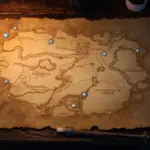
From a developer’s point of view, the easiest way to internalize the elden ring map locations is to look at the macro layout rather than individual markers. The Lands Between can be described as a central hub surrounded by radial regions, with a set of large sub-regions that connect back to the center through a mix of terrain, fog walls, and scripted transitions.
| Layer | Role in the open world | Typical player experience |
|---|---|---|
| Central hub (Leyndell, the Erdtree) | Visual and mechanical anchor, late-game destination | Reachable from multiple directions, signals endgame proximity |
| Radial main regions (Limgrave, Caelid, Liurnia, Altus, Mountaintops) | Carry the main story beats and key legacy dungeons | Identifiable from the central hub by terrain color and silhouette |
| Transitional sub-regions (Weeping Peninsula, Siofra, Ainsel, Lake of Rot) | Bridge areas that change tone or scale | Often hidden, reward exploration, change combat assumptions |
| Optional dungeon clusters | Dense, repeatable micro-levels | Spread along roads, cliff edges, and lake shores for visibility |
This shape is not unique to Elden Ring, but the way it is communicated is. The regions are not fenced off with invisible walls; the world uses elevation, water, and damage zones to push the player toward the intended path. A cliff that is technically climbable but punishingly high is a soft wall. A poison swamp that drains your resources is a soft wall. A boss at the end of a legacy dungeon is a hard wall in the form of a skill check. Reading the elden ring map locations is largely about reading which of these walls you are looking at.
How region boundaries are communicated visually
One of the most useful things a level designer can learn from Elden Ring is how region transitions are staged. There is no loading screen between Limgrave and Liurnia; the world changes color, weather, and encounter density as you ride. The boundary is communicated by:
- Skybox changes: the distant sky shifts from warm yellows and greens to cooler blues.
- Ground texture transitions: grass gives way to swamp, then to carved stone.
- Audio: music and ambient loops fade across region borders rather than cutting sharply.
- Encounter density: enemy types and group sizes change without any explicit UI signal.
- Elevation: the player is often funneled up or down a slope to mask the streaming of new assets.
For developers, this matters because each of those signals is a separate subsystem. Art, audio, encounter scripting, and streaming all have to be coordinated along the same line on the map. When the elden ring map locations feel coherent, it is because those subsystems agree. When a region feels abrupt, it is usually because one of them was not yet authored when the boundary was set.
Streaming, loading, and the cost of a big map
From a production standpoint, the most expensive part of authoring the elden ring map locations is not placing markers. It is keeping frame times stable while the world streams around the player. Ring uses a combination of traditional world partition techniques and a few practical concessions that any developer working on a large open world can learn from.
| Technique | What it solves | Trade-off |
|---|---|---|
| Cell-based world streaming | Keeps memory bounded per area | Visible pop-in near cell borders if authoring is sloppy |
| Draw distance budgeting per region | Preserves silhouette without overdraw | Far regions must be designed with simplified LODs |
| Teleport-style grace sites | Replaces fast travel menus with environmental anchors | Player can skip content, breaking encounter pacing |
| Co-op boundaries | Keeps multiplayer sessions stable | Some areas cannot be co-oped without significant extra work |
Grace sites are worth lingering on because they are part of how the map is read. From the player’s perspective, a Site of Grace is a save point and a fast travel target. From a designer’s perspective, a Site of Grace is a load boundary and a soft checkpoint. Every grace site was placed after considering what the player should be able to skip, what the player should be forced to walk past, and what the player should reach quickly after a death. The distribution of grace sites across the elden ring map locations is one of the strongest signals of intended pacing.
Reading the map as a designer: a practical checklist
When you are looking at the elden ring map locations and want to extract design intent rather than just routes, a small checklist helps. I use a version of this when I study any shipped open world:
- Identify the visual anchors you can see from any given high point. These are the landmarks the level designer trusts to read at long distance.
- Note the grace site density. Dense clusters usually mean the designer wanted fast recovery in that area, often because of harsh enemies or fall damage.
- Find the soft walls. Swamps, cliffs, and high-level enemies tell you where the intended path goes without the game having to tell you.
- Compare the visible legacy dungeon markers with their actual footprint in the world. The map is a simplified version, and the discrepancy is often the most interesting part.
- Mark the points where you had to dismount, where you could summon, and where the camera framing changed. These are the seams in the experience.
This kind of pass is useful for environment artists, technical designers, and producers who want to understand how a shipped open world balances authored intent with player freedom. It also helps players who simply want to know why a particular region feels the way it does, and why a hidden area exists in the first place.
The role of legacy dungeons in the open world
Throughout this guide I will treat the map as a piece of shipped content: a set of regions, transition rules, and load boundaries that interact with traversal, encounter pacing, and visual wayfinding. I will avoid exact coordinates or invented secrets. Where I reference region names, structure, or mechanics, I am drawing on the published description of Elden Ring’s open world and how it has been discussed in design retrospectives, not on unverified datamining. The general background of the game’s production and structure is documented on its Wikipedia page, and a practical reference for how individual dungeons sit inside the wider overworld is PC Gamer’s dungeons locations guide, which is the kind of resource I keep open while reading a map like this.
Legacy dungeons are the most expensive pieces of content in Elden Ring, both in art and engineering. They are full indoor levels with their own internal logic, and they sit on the same map as the overworld. From a developer’s perspective, the way they are stitched into the elden ring map locations is more interesting than the dungeons themselves.
Each legacy dungeon is introduced by a visible silhouette and a clear approach path. Stormveil is on a cliff and looks like a castle. Raya Lucaria is across a lake and looks like a magic academy. Leyndell sits inside a capital city. The map tells you, before you load in, that you are about to enter a structured level with a boss, shortcuts, and a defined shape. The player’s expectation is set by the map marker, the camera framing, and the immediate surroundings.
This matters because it is the opposite of how most open worlds treat dungeons. Many games scatter dungeon icons uniformly and let the player discover the contents by trial and error. Elden Ring instead uses the overworld to teach the player what kind of experience each marker represents, which is one of the reasons its map feels authored rather than procedural.
Optional dungeons, catacombs, and the value of density
Optional dungeons are the bulk of the elden ring map locations in sheer count. They are short, dense, and forgiving to author because they use a small number of reusable room kits. For developers, the interesting question is how to place them so the world reads well.
A few principles can be inferred from how they are distributed:
- Optional dungeons tend to be near roads and visible from a short distance, so the player can choose to engage or skip them without feeling like they missed something secret.
- They are paired with grace sites, so a failed run can be repeated without a long ride back.
- They are not evenly distributed. Certain regions have noticeably more optional dungeons than others, which affects how long a player will spend in that region.
- They are reused as encounter arenas for specific enemy types, which keeps art and animation costs lower than a fully bespoke dungeon would be.
For a level designer, this is a useful pattern. Optional content is most effective when it is visible enough to invite the player but short enough that the player can leave without losing progress. A well-placed catacomb in Elden Ring is a small promise: ten minutes of focused combat, a reward, and a return to the open world.
How map design supports co-op and asynchronous play
Ring’s multiplayer is unusual because it is woven into the open world rather than being a separate mode. Summon signs appear in the world, and the player can leave messages, bloodstains, and ghost replays on the terrain itself. That design choice has consequences for how the elden ring map locations are authored.
Every interesting location in the world is also a potential multiplayer surface. A cliff with a view is a place where a message might appear. A boss door is a place where a summon sign might appear. A narrow bridge is a place where a hostile phantom might invade. The level designer has to author these moments without knowing whether any other player will be present. This is one of the reasons the world uses strong silhouettes and clear landmarks: even when the world is empty of other players, it has to feel like a shared space.
There are also practical limits. Not every region in the elden ring map locations can be entered in co-op without extra work, and some legacy dungeons have co-op restrictions that the world map hints at but does not explain. From a development standpoint, this is the cost of the design: an open world that supports asynchronous and synchronous play requires more careful streaming, more careful encounter scripting, and more careful layout than a single-player-only world would.
Why the map reveals more after multiple playthroughs
One of the most discussed features of the elden ring map locations is that they do not feel fully revealed until the player has run through the world more than once. The compass fills in gradually, fragments of the map are found in the world, and certain regions remain partially hidden until specific events trigger. This is a deliberate pacing decision.
From a design perspective, the staggered reveal does three things at once. It reduces the cognitive load on the first playthrough, when the player is still learning the combat system. It creates a sense of discovery on subsequent runs, when the player is hunting for builds and endings. And it gives the development team room to add or move content in patches, because the player is not yet seeing the full map in any given run.
For developers, the lesson is that a map can be a progression system as well as a navigation system. A map that reveals itself in step with the player’s capability is a map that scales with the player’s experience.
How world state and NPC quests reshape the map
Map reading in Elden Ring is also a study in conditional space. Several elden ring map locations only become meaningful, accessible, or visible after an NPC quest has progressed, an area boss has been defeated, or a Great Rune has been activated. The same stretch of terrain can be hostile, neutral, or friendly depending on the player’s actions hours earlier. For a designer, that is a useful constraint to study because it forces every region to have at least two readings: the reading the player gets on first contact, and the reading the player gets after a state change.
This is also where production cost shows up. Conditional geometry, alternate spawn tables, and faction-aware enemy placement are all expensive to maintain. When the team makes a region behave differently under different world states, they are accepting more bug surface, more QA hours, and more documentation. The fact that Elden Ring does this across a large map without the seams becoming obvious is a quiet achievement of tooling and review.
Verticality, elevation, and how the world folds back on itself
The Lands Between is unusually vertical for a game of this scale. A single cliff face can connect a swamp, a cavern, a legacy dungeon, and a rooftop. This is one of the most copyable ideas in the elden ring map locations: the world is not just a flat plane with landmarks, it is a stack of plates, and the player is allowed to drop between them in controlled ways.
For level designers, verticality is a way to add interest without expanding footprint. A small footprint that uses height cleverly can deliver more memorable traversal than a large footprint that is mostly flat. Elden Ring’s Siofra River, Ainsel River, and Deeproot Depths are good examples of this: each one reuses geometry the player has already seen, but flipped, inverted, or hidden underground, so that familiar silhouettes feel strange again.
Verticality also helps with streaming. When the player is moving up and down through layered space, the engine can swap in a different cell without the player noticing a pop. That is part of why the transitions in the elden ring map locations feel smoother than the size of the world would suggest.
Lighting, time of day, and how the map changes mood
Another way the elden ring map locations guide the player is through lighting. The world has a day-night cycle, dynamic weather, and region-specific palettes. Caelid reads as hostile partly because of its red sky, not only because of its enemies. Liurnia reads as magical because of the soft purple-blue light that hangs over the lake. The lighting is doing narrative work that the quest log never has to do.
For developers, the lesson is that lighting and atmosphere can replace HUD elements. A region can communicate threat level through the color of its sky, the density of its fog, and the angle of its shadows, instead of through a difficulty number on the map. This is harder to author than a marker, but it scales better, because a single lighting state covers every object in the region at once.
Common design lessons from the Elden Ring map
If you distill what the elden ring map locations teach a working developer, the lessons tend to cluster around a small set of themes. None of these are unique to Elden Ring, but together they form a coherent design language that is worth studying.
- Visual silhouette matters more than icon density. A world that reads from the horizon is a world that does not need a quest marker.
- Region transitions are a coordinated art, audio, encounter, and streaming problem. Treat them as a single feature, not four.
- Optional content is most effective when it is short, visible, and recoverable. Players should be able to opt in or out without losing progress.
- Multiplayer and single-player share the same world. Authoring for one means authoring for the other, even when no one else is online.
- Map reveal is a pacing tool. A map that opens in step with the player keeps both new and experienced players engaged.
These are not rules; they are the kind of trade-offs that have to be weighed against the specific project, the target hardware, and the available production time. But they are the trade-offs that the elden ring map locations are visibly built around.
Limitations and what a developer cannot learn from the map alone
It is worth being honest about what a study of the elden ring map locations cannot teach. The map is a finished artifact, and the reasoning behind specific placements is not always recoverable from the outside. We can infer intent, but we cannot verify it. A region may be placed where it is for art reasons, for performance reasons, for narrative reasons, or for a combination of all three, and the shipped map rarely disambiguates which.
It is also worth remembering that the map is the result of a particular team, a particular engine, and a particular moment in hardware capability. Techniques that work on the platforms Elden Ring targets may not translate directly to a different project with a different budget. The right way to read a shipped open world is to ask what problem each design choice appears to solve, not to copy the choice itself.
A third limitation is patch drift. The elden ring map locations that players see today are not identical to the map that shipped on day one. Balance changes, NPC quest revisions, and DLC additions have all adjusted what the world contains and how it routes. Any developer treating the map as a fixed reference should be aware that they are studying a moving target, and should anchor their notes to a specific patch if they want to reproduce their analysis.
Practical next steps for developers studying the map
If you are using the elden ring map locations as a case study for your own project, a small list of next steps will get you more out of the exercise than a long passive review.
- Pick one region and recreate its silhouette in a block-out, without any decoration. How much of its character survives without textures or lighting?
- Time the walk from one grace site to the next. Compare that time to the intended length of the encounter in between. Is the pacing consistent?
- Note every place the camera framing changes. These are the moments the designer is doing the player’s looking for them.
- Identify three soft walls and ask whether your own project uses soft walls, hard walls, or both, and whether the player can tell the difference.
- Compare the visible map markers to the actual world geometry. The differences are usually more instructive than the similarities.
These exercises are deliberately small. The point is not to reproduce the Lands Between in your own engine, but to internalize the design moves that make the elden ring map locations work as a piece of shipped content. Once those moves are internalized, they show up naturally in your own level design, whether or not you are building a fantasy open world.
Frequently asked questions
How many major regions are there in the elden ring map locations?
The overworld is structured around a central hub and a set of radial regions that connect to it through terrain, water, and scripted transitions. The exact number of named regions is less important than the way they are arranged: a central anchor, several main regions, and a number of transitional sub-regions that bridge between them. Reading the map by role rather than by name makes it easier to understand the design intent.
Are legacy dungeons marked differently from optional dungeons on the map?
Yes. Legacy dungeons are shown with distinct markers and are usually introduced by a strong silhouette and a clear approach path. Optional dungeons use a different marker and tend to be placed near roads or visible terrain features. The visual distinction helps the player choose between a long, structured level and a short, repeatable micro-level before they commit.
Why do some elden ring map locations only appear after a trigger?
Map reveal is used as a pacing tool. The compass and the world map fill in gradually so that the player is not overwhelmed on a first run, and so that later runs still have new things to discover. Specific icons can also be tied to quest progression or world state, which means a region may not show up until the relevant event has been triggered.
How do grace sites shape the experience of moving through the map?
Grace sites act as both save points and fast travel targets, but they also act as soft checkpoints. The density of grace sites in a region tells you a great deal about how the designer expects the player to engage with that region, and how recoverable a failed attempt should feel. A dense cluster of grace sites usually means harsh enemies, fall damage, or both.
What can a developer learn from the way the map handles region transitions?
Region transitions in Elden Ring are coordinated across art, audio, encounter scripting, and streaming. They do not rely on a single signal. For developers, the lesson is that a good region transition is a multi-system feature, not a single asset. When transitions feel abrupt, it is usually because one of those systems was not yet authored when the boundary was set.
How does co-op affect the design of the elden ring map locations?
Co-op is woven into the same world as single-player. Every interesting location is also a potential multiplayer surface, and the level designer has to author these moments without knowing whether another player will be present. This shapes where summon signs can appear, where invasions can happen, and which regions can be entered cooperatively without extra engineering work.
Why does the map feel different on a second playthrough?
On a second run, the player is no longer learning the combat system and is instead hunting for builds, endings, and missed content. The staggered map reveal rewards that shift in attention by making parts of the world feel new again. It also gives the development team room to add or move content in patches, because the player is not yet seeing the full map in any given run.
Can the design patterns of the elden ring map locations be applied to a non-fantasy project?
Yes, with care. The patterns are about wayfinding, soft walls, region transitions, and optional content density, none of which are specific to fantasy. The most portable ideas are visual silhouette, recovery density, and the use of soft walls to guide attention. Translating them into a different setting or genre usually means adjusting the visual language, not the underlying structure.
How does the vertical layout of the map help the player navigate?
Verticality is used as a navigation aid as much as a level design tool. Cliffs, rooftops, caverns, and underground rivers give the player several ways to read the same area, and shortcuts that drop the player back to a familiar grace site make large distances feel shorter. For developers, vertical layering is a way to pack more interesting traversal into a smaller footprint.
What changes about the map when world state shifts?
Several areas change enemy placement, lighting, or accessibility after major bosses are defeated or key NPC quests progress. The same region can feel like a different level under a different world state, which is part of why replays continue to feel fresh. For developers, this is an example of using world state as a level design tool rather than as a quest log entry.


Leave a Reply