
Terrifier 4 and what the slasher IP means for interactive horror development
The confirmed next chapter in Damien Leone’s slasher series has not been released in any official capacity as of late October 2026, but the franchise’s production history already gives game developers a useful case study in how an indie horror property grows, how a single villain becomes a product line, and how practical-effects-first design choices influence everything from licensing to runtime budget. For a developer or technical artist scoping a horror project, the Terrifier property is worth reading as a production text as much as a film series, and the early development context of Terrifier 4 illustrates several recurring decisions in interactive horror that the independent film side of the franchise has been working through for almost a decade.
What the franchise’s production record actually documents
The Terrifier series started as a pair of short films and a breakout character rather than a planned film franchise. According to the verified record, Art the Clown first appeared in the short film The 9th Circle in 2008, returned in the 2011 short Terrifier, and then anchored the anthology film All Hallows’ Eve in 2013. The 2016 feature Terrifier was written specifically as a vehicle for the character and the practical-effects work that grew around him, and the franchise expanded into Terrifier 2 in 2022 and Terrifier 3 in 2024.
Three production patterns are worth pulling out for game developers because they recur in interactive horror as well:
- The IP grew upward from a single asset (Art the Clown) rather than from a written story, which mirrors how many horror games start from a single creature or location concept before the systems around it stabilize.
- Funding came from outside the traditional studio system, with the original feature financed after an Indiegogo campaign fell short and producer Phil Falcone stepped in, the same structural risk that small studios face when pitching a slasher game to publishers.
- Each escalation kept the same core constraint, which is a high tolerance for graphic practical gore, and used that constraint as a marketing asset instead of treating it as a problem to soften.
Those three points shape the development context for Terrifier 4 in much the same way they shape any indie horror sequel in games. The character is the franchise, the budget path is fragile, and the tone is a feature, not a bug.
How a slasher IP expands in the gap between films
For an interactive project, the most useful way to read the run-up to a sequel like Terrifier 4 is to map what the franchise actually monetized and built between entries, because those are the same surfaces a game team would have to build or license. The film series is described in the verified record as generating a media franchise from what was originally a low-budget independent feature, with the sequels following in 2022 and 2024. The expansion pattern matters more than the specific revenue numbers, which the source does not provide.
A practical way to look at it is to compare the surfaces a slasher franchise typically opens up against the ones a game team would actually have to build.
| Franchise surface | What the film series has done | What an interactive version must build |
|---|---|---|
| Main antagonist | Art the Clown carried as a single reusable asset across shorts, anthologies, and features | A reusable controller or AI package with deterministic kill states |
| Victim pool | Recurring human cast with limited screen time per entry, designed to be expendable | A systemic victim generator, including crowd and NPC layers that can be culled without breaking scenes |
| Setting | Halloween-night locations in Miles County, New York, reused with variations per entry | Modular location kits that can be re-skinned and recombined per sequel |
| Practical effects | A core selling point, with on-set hacksaw and gore work referenced as headline moments | Decals, fluids, and dismemberment systems, often on a cloth and rig base the engine can re-target |
| Tone | Graphic violence presented without comic relief offsets, treated as a brand attribute | Content warnings, rating submissions, and platform certification scope tied directly to that tonal promise |
Read that way, the franchise is a useful reference for any horror studio planning how to keep a property alive between major releases. The pattern is: protect the main asset, keep the victim pipeline cheap, and let the tone do the marketing work.
Production decisions in the Terrifier 4 development window
The verified record does not document a green-light, a release date, or a release platform for Terrifier 4 as of late October 2026, and the editorial position of this site is to leave those questions to official channels. There is, however, a clear development context that any team tracking the property should treat as load-bearing: the franchise has released a new film roughly every two years, the previous entry arrived in October 2024, and the production cadence established by writer-director Damien Leone tends to follow festival premieres in the fall.
For a developer, the relevant question is not when the next film arrives, but what the production cadence implies about the assets, tooling, and team structure that a new entry has to absorb. The 2016 feature is documented as having been written with a deliberately simple, linear narrative so the practical-effects work could be the focus, and the writer has been quoted in the verified record as regretting the underdeveloped handling of the surviving sister character. That kind of trade-off is a classic example of a content team choosing to invest in a single high-impact vertical slice rather than in a balanced horizontal feature set.
The same trade shows up in games every time a studio decides to push one boss encounter, one chase sequence, or one scripted death scene far past the rest of the content budget. When that decision is part of a franchise plan, the gaps start to look like sequels instead of like bugs, which is one reason a small horror game often reads as a series of set pieces strung together rather than as a continuous system.
Why the Art the Clown asset design matters for an interactive project
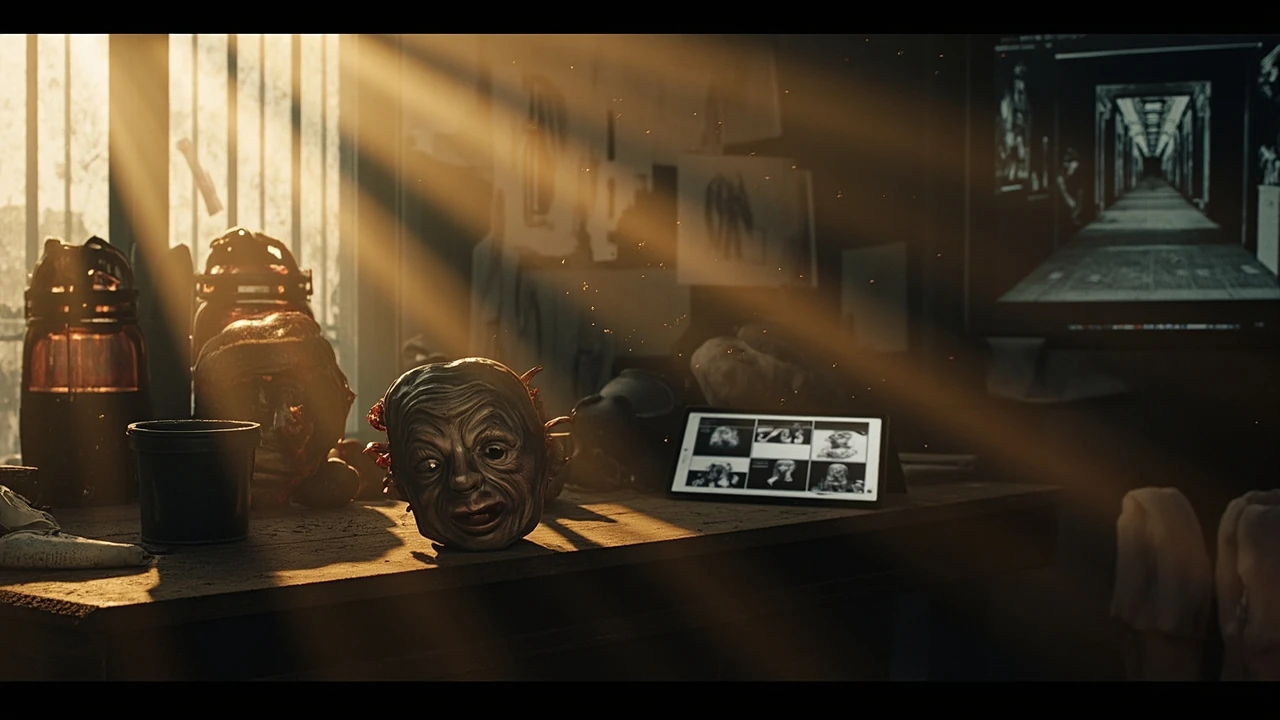
Art the Clown is a particularly interesting test case for character asset design because the character is a near-silent, mime-driven figure. The verified record describes the character as a serial killer whose portrayal relies on physical performance rather than dialogue, and notes that the actor was cast after improvising a kill scene in mime. From a runtime perspective, that choice has a long tail.
A silent or near-silent antagonist changes several things in a game production:
- Animation budget is concentrated on locomotion, idle, and kill states, with no lip-sync or dialogue tree budget attached to the main villain.
- AI behavior has to carry more narrative weight, because the character cannot speak, which raises the cost of telegraphing threat.
- Marketing assets are easier to localize because the character does not speak, which is a non-trivial advantage for studios planning multi-region releases.
- Replacement of the performer between entries is cheaper than it would be for a voiced lead, which the franchise has already exercised by swapping actors in earlier shorts.
The broader lesson is that a slasher IP often makes most of its design cost back on the villain, and any sequel has to protect the villain’s signature states. A team that lets a main creature be replaced by a more efficient but less expressive rig, or that splits the antagonist’s time between a heavy cinematic mode and a lighter gameplay mode without a clean transition, tends to lose the franchise feel.
Practical effects as a pipeline constraint, not just an aesthetic
The original Terrifier is repeatedly framed in the verified record as a showcase for practical gore and effects work, with the writer-director stating that the feature was written specifically to highlight Art and his effects. The hack-saw sequence and the cat o’ nine tails attack on Victoria are both cited as anchor moments, and the production is described as a low-budget independent shoot that committed to in-camera effects where many peers would have leaned on digital substitutes.
For an interactive project, that pipeline decision has a near-direct equivalent in the choice between baked mesh gore, runtime fluid sims, and decal-driven dismemberment. Each path has a different cost on frame time, asset memory, and content team workload.
| Effects path | Strength in a slasher context | Cost a small studio should plan for |
|---|---|---|
| Baked mesh swaps | Predictable frame time and easy certification across platforms | Heavy art team load, limited runtime variation, large disk footprint for unique death variants |
| Decal-driven gore | Fast iteration, easy re-skin, low memory cost | Silhouette breaks under close camera angles, requires careful normal and lighting matching |
| Fluid or particle systems | High visual payoff per asset, scales to many victim types | GPU cost, fluid solver tuning per platform, longer QA cycle for certification |
| Hybrid practical-capture reference | Anchors the look to real reference, useful for art direction | Requires a small motion-capture or shoot day, plus clean-up of captured data in-engine |
The Terrifier production record makes the strongest case for a hybrid approach: use real on-set effects as reference and as a marketing surface, and let the engine layer the runtime variation on top. Teams that have shipped slasher games in this configuration often report that the practical reference pass is what keeps the digital gore from drifting into a generic look over the lifetime of a franchise.
Funding path and the structural risk of a slasher IP
This article treats the focus keyword Terrifier 4 as a current-development spoke inside a broader horror-IP hub. It pulls only on the verified record of the original film as confirmed on the franchise’s Terrifier entry, then connects those production decisions to engine, asset, and design choices a small studio would face when adapting or competing with that kind of property in a game. The goal is to give a developer, technical artist, or producer a defensible framework for thinking about a slasher IP at the moment the next entry is being shaped, not to speculate about release dates, casting, or plot.
The original feature was funded through a mix of a crowdfunding shortfall and a private investor stepping in after the campaign fell short, with producer Phil Falcone providing the rest of the budget in exchange for a producer credit. That funding shape is one of the cleanest real-world examples of a slasher IP bootstrapping itself, and it has obvious parallels in indie game production where a studio closes a small seed round or a publisher advance after a failed or partial crowdfunding push.
The Terrifier 4 development window inherits that history whether the team wants it to or not. The franchise has already proven that the IP can carry a feature budget, and a new entry therefore has to clear a higher bar of recoupment than the original did. For a developer, that has three concrete implications:
- The franchise has demonstrated a willing audience for a specific tone, which is the kind of pre-validation a publisher typically asks for before green-lighting a sequel.
- The cost of the sequel has to grow carefully because the audience is a niche one, which argues for the same “set-piece over horizontal content” trade-off the original film made.
- Legal exposure around the property has become a real line item, not a theoretical one. The verified record includes a 2025 federal lawsuit filed by actress Catherine Corcoran against the filmmakers, alleging shortchanged residuals and unauthorized use of nudity, with a stated denial from the named defendants. Any team that signs a deal around the property has to budget for contractual clarity on residuals, likeness rights, and on-set documentation.
None of those points is unique to this franchise, but they are unusually visible here because the production history has been documented publicly, and the lesson generalizes to any slasher game pitched off an existing horror IP.
Audience modeling for an interactive Terrifier 4
The Terrifier audience is, in marketing terms, a clearly defined niche that tolerates graphic content in exchange for a specific kind of practical-effects commitment. From a product perspective, that audience definition is unusually clean, which is one reason horror projects pitched off established properties tend to clear green-light review faster than more original pitches.
A small studio planning an interactive Terrifier 4 product would want to model that audience along three axes at minimum.
| Audience axis | What the franchise record suggests | What the interactive version has to satisfy |
|---|---|---|
| Tone tolerance | High tolerance for graphic practical gore, low tolerance for comic relief or self-parody | Rating submission strategy, content warnings, and design restraint on quippy dialogue |
| Set-piece expectation | Audiences arrive for named kill scenes, not for plot | Vertical-slice budgeting that over-invests in 3 to 5 anchor moments per chapter |
| Continuity appetite | Audience tracks returning characters and setting details across entries | Reusable character rigs, modular locations, and a content pipeline that supports 2 to 3 years of sequel releases |
None of this tells a studio to copy the franchise, but it does suggest a useful rule of thumb: a slasher product succeeds when the audience can name the three things they came for, and a sequel lives or dies on whether those three things return. For an interactive Terrifier 4, that almost certainly means Art the Clown, at least one named returning character, and a location that echoes Miles County in some form. A pitch that drops any one of those three is not the same property.
Engine, platform, and certification choices the franchise implies
Because the property is so effects-heavy, platform certification deserves a separate line in any planning document. The 2016 feature carried a restricted rating in many markets, and the marketing of later entries has leaned on that rating as a selling point rather than treating it as a constraint. A game built on the property will have to commit to the same position, which tends to push the project toward PC first, with console ports handled carefully to satisfy regional certification.
There are some practical decisions that fall out of that commitment:
- Engine choice tends to favor a real-time path tracing or forward+ setup that can hold up under heavy particle and fluid loads, because the gore has to read at 30 frames per second minimum across the certified platforms.
- Animation rigs need a clean separation between locomotion, kill states, and environmental interactions, because the same rig is likely to be re-used across sequels and possibly across a future Terrifier 5 if the franchise continues.
- Audio design has to support a silent antagonist, which means ambient and sting composition carry more of the narrative load than in a typical action game.
- Save and checkpoint design has to respect the franchise’s preference for linear set-pieces, which argues for chapter-based structure rather than open world scaffolding.
These choices are not unique to the property, but the franchise’s history makes them more visible because the original production already traded narrative scope for a few anchor scenes, and a new entry is likely to inherit that shape.
What a small studio should actually plan for
Pulling the production context into a planning document, the Terrifier 4 window looks less like a single product and more like a recurring content slot. The useful planning artifacts are the same ones a small studio would build for any horror sequel in a live-content or episodic model.
- A villain rig that can be re-targeted to new animations without re-authoring the core silhouette.
- A victim pipeline that can absorb new NPC variants without re-coding the AI or the kill-state system.
- A location kit that allows a small art team to ship a new setting every 18 to 24 months by recombining existing modules.
- An effects library, ideally built off a hybrid of practical reference and in-engine authoring, that keeps the gore look consistent across sequels.
- A content-warning and certification checklist tuned to the franchise’s established tone, so the marketing promise and the rating submission match from day one.
The list is conservative, but it matches the franchise’s actual production pattern. The first feature was written to showcase a single character and a set of effects. The sequels kept that shape. A small studio betting on the property should plan to do the same.
Where the framework breaks
It is worth being honest about the limits of this analysis. The verified record for the franchise covers the 2016 feature in detail, with shorter notes on the 2022 and 2024 sequels, and does not document the production plan, release window, or platform strategy for Terrifier 4 specifically. Any concrete release-date or cast information is out of scope for this page and would be premature to publish.
The framework also assumes the franchise keeps the same tone and structure, which the production record supports but which a new writer-director or a new investor could change. Studios that pitch off the property should keep optionality on tone and structure in the contract, not assume continuity from one entry to the next.
Finally, the lawsuit filed in 2025 is a reminder that the production history of even a small slasher franchise carries real contractual exposure. Any deal around the property should treat residuals, likeness rights, and on-set documentation as live legal work, not boilerplate, and the budget should reflect that.
What to do with this context today
For a developer reading this in the Terrifier 4 development window, the most useful next step is to treat the franchise as a production reference and a competitive anchor, not as a template. The original feature is a clean case study in how a slasher IP can be bootstrapped from a single character, how a tone can become a brand attribute, and how a small team can ship a property that survives multiple sequels. None of that guarantees the next entry will be a hit, but it gives a small studio a defensible framework for pitching, scoping, and budgeting a horror project that wants to compete in the same niche.
A practical move today would be to map the three audience anchors named above against whatever pitch deck the team has, drop any anchor that the project cannot deliver, and budget the remaining ones as set-pieces rather than as background content. That is the same trade-off the original Terrifier made in 2016, and it is the trade-off a Terrifier 4 product will have to defend in green-light review if it wants to keep the franchise’s tone and structure intact.
Frequently asked questions
Is Terrifier 4 confirmed for release?
No public, verified release date for Terrifier 4 is included in the source material reviewed for this page. Any team tracking the project should treat official channels as the only reliable source for a release window, and should avoid quoting retail listings or unverified reports as if they were confirmed facts.
What makes the Terrifier franchise interesting from a game development perspective?
The franchise is a clean example of an indie horror property built around a single reusable antagonist, a fixed tone, and a small core team. That shape maps well to the budget and risk profile of an independent horror game, and it is one of the better real-world cases of an IP scaling upward without losing its original production identity.
How should a small studio budget effects work for a horror game pitched off a slasher IP?
Most teams in this situation plan for a hybrid pipeline that uses practical reference footage to anchor the art direction and an in-engine layer of decals, fluid systems, or mesh swaps to deliver the runtime variety. A pure baked-mesh approach tends to be too expensive to maintain across sequels, and a pure runtime simulation tends to be too costly to certify across console platforms.
Why is the villain’s silent design such a big deal for production cost?
A silent or near-silent antagonist removes lip-sync and dialogue-tree work from the most expensive asset in the game. That saves budget on animation, audio, and localization, and it lets the AI and locomotion work carry the character’s identity. It is one of the cheapest ways to give a horror IP a recognizable silhouette across sequels.
What legal exposure should a studio plan for when licensing a slasher property?
The Terrifier production record already includes a federal lawsuit filed in 2025 with allegations of shortchanged residuals, unauthorized use of nudity, and a denial from the named defendants. Any deal around an existing horror property should treat residuals, likeness rights, and on-set documentation as live legal work, and the budget should reflect the cost of getting those contracts right.
What engine and platform choices does a slasher IP push a studio toward?
Effects-heavy slasher projects tend to favor engines with mature particle and fluid tooling, real-time lighting that holds up under heavy post-process work, and a path to console certification without dropping the franchise’s tone. A PC-first release with careful console ports is a common path because the rating submission and certification work is more controllable there.
How does a horror franchise keep its tone across sequels?
Most successful horror sequels protect three audience anchors, which in this case would be the main antagonist, at least one named returning character, and a recognizable setting. Dropping any one of those anchors usually reads to the audience as a soft reboot rather than a sequel, and that is a much harder marketing proposition to defend.
What is the right way to track a Terrifier 4 production update?
The right approach for a developer is to watch for official announcements from the writer-director and the production company, treat festival premieres as the most likely public reveal moment, and ignore retailer listings or aggregator dates that do not have an official source behind them. Treating the property as a moving target until the official record catches up is the safest professional stance.

Leave a Reply