
Absolute Joker in the Absolute Universe: how the character is built and where he appears
The Absolute Joker sits at the far end of DC’s 2024 relaunch of its main line, a project that rebuilt Batman, Superman, Wonder Woman and their rivals inside a separate timeline called the Absolute Universe. For readers who already know the modern mainline Joker, the interesting question is not whether the Absolute version is a copy. It is which design choices survived, which ones were inverted, and how the creative team uses him as a slow-burn antagonist across a monthly series rather than a single arc. The Absolute line is also one of the clearest current examples in mainstream American comics of treating villain design as a long-term production problem, not just a one-off cover concept, so it is worth tracing how the character is shaped, when he shows up, and what production decisions surround him.
This page focuses on the Absolute Joker as a character and a production object, drawing on the structure of DC’s Absolute line and the way his role has been sequenced through the early issues. It is written for readers who already know mainstream DC continuity, and who want a careful read on the design choices, the publication timing, and the editorial decisions that shape how the villain lands in monthly issues. It is not a Joker encyclopedia, and it is not a generic “why villains matter” essay; the goal is to walk through what the Absolute Universe is, where the Absolute Joker fits inside it, and what a reader or a comics-adjacent creator can learn from the way this particular antagonist has been staged.
What the Absolute Universe actually is
The Absolute Universe is a parallel DC line launched in 2024 that resets the publisher’s most recognizable characters for a new generation of readers. The flagship title, Absolute Batman by Scott Snyder, Nick Dragotta and Frank Martin, began with issue #1 on October 9, 2024, and is structured around an underlying “Darkseid energy” that allows the creative teams to rework origins, relationships and power sets without being chained to decades of mainline continuity. The line is built so that newcomers can read any of the Absolute titles as a starting point, which is unusual for a shared superhero universe, and most titles in the line are designed to be approachable on their own.
For the Absolute Joker specifically, that reset is the most important context. The character is not written as a continuation of the long-running mainline Joker from Batman, the animated series, or the Arkham games. He is a new construction whose job is to oppose an entirely new Batman, and his pacing across the line reflects that. The Absolute line is also published on a regular monthly schedule, with collected trade editions of roughly six to eight issues releasing about every six months, which means villains in this line are often designed to be reread and re-evaluated as more issues come out. That structure has a direct effect on how the Absolute Joker is drawn, written and revealed: small, single-issue appearances carry more weight when the reader knows the trade will collect them into a larger arc.
Where the Absolute Joker sits in the line
The Absolute Joker is treated as a background presence in the early arcs of Absolute Batman and as a more direct threat in later issues. The character is built up from the first arc onward, with most of the on-page appearance concentrated in single issues and crossover one-shots rather than as a continuous co-protagonist. The clearest example of this staging is the Universe-wide one-shot Absolute Evil, where the Absolute Joker meets other central villains of the Absolute line, including Ra’s al Ghul, and the character is positioned as a coordinator of the wider threat rather than as a single-arc antagonist.
That role influences everything else about him. Because the character is meant to feel like a presence behind the curtain, his design leans into contrast and silhouette, and his dialogue is usually kept sparse. Issue-level beats that would be a full confrontation in a mainline Batman story are often reframed as teases, single panels, or single-issue set pieces. For anyone reading the Absolute line in single-issue format, this can feel slow; for readers collecting the trades, it gives the character a payoff pattern similar to a long-form prestige TV villain rather than a monthly punching bag.
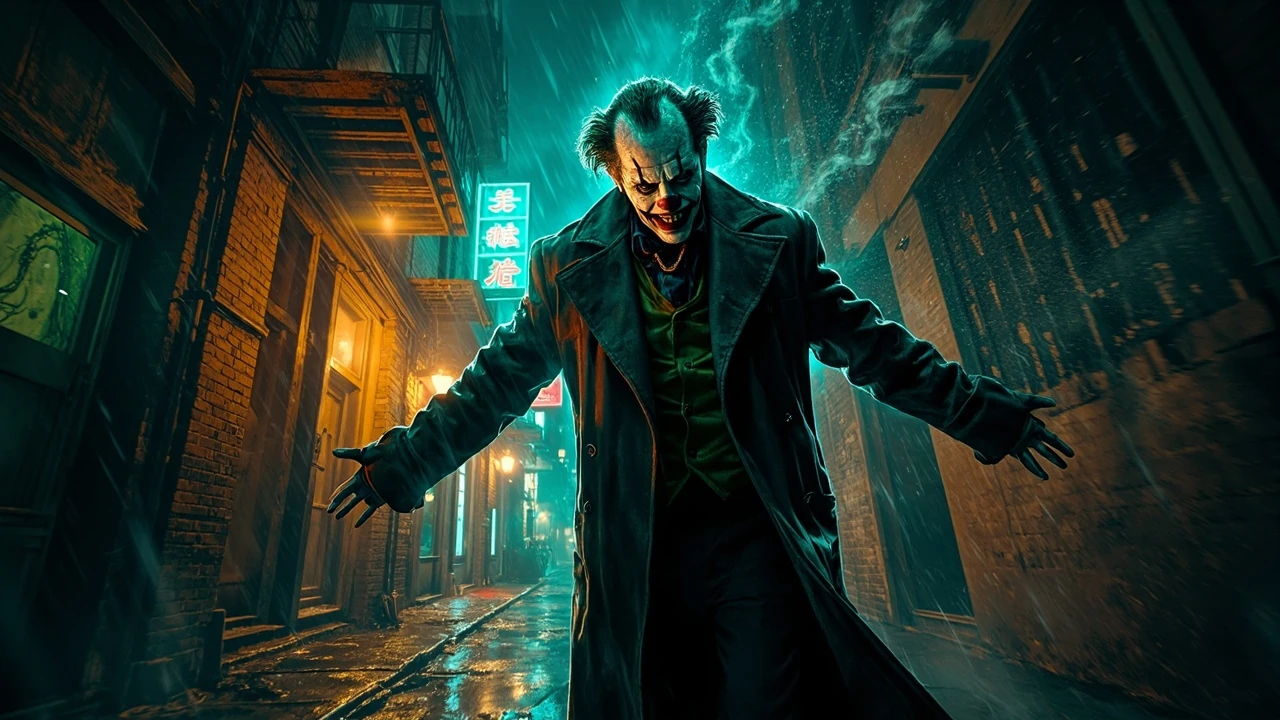
How the Absolute Joker is designed
The visual identity of the Absolute Joker leans into a handful of clear production choices, each of which has a function in the line’s broader aesthetic.
- Strong silhouette. The character is drawn to be readable at a distance and in small panels, with a head shape, coat line, and stance that read instantly even when his face is partially in shadow.
- Restrained color. Rather than the bright purple of several earlier versions, the Absolute line uses a more muted palette across its villains, and the Absolute Joker’s color story is built around contrast with the surrounding environment rather than saturation.
- Body language over dialogue. Many of his strongest moments are staged with posture and expression rather than speech, which is a deliberate choice for a character whose role is to feel like he is always watching.
- Darkseid-influenced framing. The “Darkseid energy” concept that defines the Absolute line shows up in the way the character is lit and staged, often with a faint wrongness in the environment that signals his presence without a word balloon.
These choices matter for production. A villain who is meant to anchor multiple arcs over a multi-year publishing run has to be visually consistent enough that readers recognize him in a single panel, but flexible enough that artists can place him in very different page layouts. The Absolute Joker’s design is built to satisfy both constraints at once, which is one of the reasons the early issues repeatedly use small, quiet appearances of him rather than large splash-page reveals.
Where he actually appears in the early issues
The Absolute Joker’s appearances are concentrated in three kinds of pages, and understanding that distribution is the easiest way to track his role in the line.
| Appearance type | Where it shows up | Editorial purpose |
|---|---|---|
| Background tease panels | Early arcs of Absolute Batman, often at the edge of a city shot or inside a separate scene | Establish the character as a long-term threat without forcing a confrontation |
| Issue-level focus | Single issues such as Absolute Batman #15, with one-off collaborators on art duties | Deliver a focused character beat, often a flashback or origin fragment |
| Universe crossover | The Absolute Evil one-shot and related specials, alongside other Absolute villains | Position the character as a coordinator of the wider Absolute threat |
The split between these three modes is not accidental. Mainline DC has historically struggled with making the Joker feel like a serious long-term antagonist because he is over-exposed in a way most other villains are not; almost every Batman era has a Joker arc, and the character can drift between tones. The Absolute line’s solution is to use the trade structure to hide his appearances inside collected editions, so that a reader following the trades gets a slow build, while a reader following single issues gets the same material spread out across many months.
Reading order and how the Absolute Joker is paced
Because the Absolute line is designed as a friendly on-ramp, the Absolute Joker’s role reads correctly even if a reader starts with the trade collections rather than the single issues. The recommended approach is to read in the order the trades publish, since the creative team uses trade-level pacing to control how much of the character is revealed in each collected volume. Reading single issues out of order, by contrast, can give a false sense of either oversaturation or absence; the character is doing real work in the background, but a single-issue reader may not see it unless they are paying attention to the page corners.
A practical reading plan for someone who only wants the Absolute Joker material would be:
- Read the early Absolute Batman trade containing the first arc, focusing on any panel that includes a background figure matching the character’s silhouette.
- Read the trade that collects the Bane-focused “Abomination” arc, since the Absolute Joker’s presence is part of the build toward later issues.
- Read the standalone issue(s) that focus on the Absolute Joker, such as Absolute Batman #15 and the “Ark M” one-shot, which are designed to read as single pieces.
- Finish with the Absolute Evil one-shot, which positions him inside the wider Absolute line.
This is a Joker-first path, not a Batman-first path, and it is useful for readers who specifically want to study the character rather than the line as a whole.
Comparison: how the Absolute Joker differs from mainline versions
The easiest way to understand what the Absolute Joker is doing is to compare him with the mainline Joker, and with the version most readers will have seen most recently in other media.
| Element | Mainline DC Joker | Absolute Joker |
|---|---|---|
| Origin weight | Often deliberately unclear, with conflicting versions across decades of comics | Built around a single, controlled origin fragment that the line is willing to revisit |
| Tone | Ranges from camp to horror depending on creative team and era | Consistently staged as a serious, slow-burn threat with limited dialogue |
| Role in the line | Frequent co-lead, often the headline villain of multiple arcs | Background presence in most issues, headline only in specific one-shots and crossovers |
| Reader on-ramp | Often requires significant continuity knowledge to fully understand | Designed to be readable as a starting point, even without mainline history |
The interesting production point is that the Absolute line has chosen a Joker who is, in a sense, less of a Joker. The character is still recognizable as the same archetype, but the line has cut back on the comedy, cut back on the dialogue, and cut back on the headlining. That is a deliberate trade: the character becomes less of a star vehicle, but more effective as a long-running threat inside a shared universe.
Why the design choice works as a production strategy
For anyone working in adjacent creative fields, the Absolute Joker is a useful case study in how to design a recurring antagonist inside an ongoing serialized property. Three choices stand out.
- Restraint over novelty. The character is recognizable because the line is willing to repeat the same silhouette, posture, and color cues in every appearance, rather than reinventing him each arc.
- Stage the reveal. The line uses single issues, one-shots, and crossover events as separate reveal vehicles, which gives the writers room to pace his escalation across a multi-year run.
- Use the trade structure. The collected editions are not just a reprint format; they are the unit at which the Absolute Joker’s arc becomes legible to a casual reader.
None of these are unique to comics, but they are unusually visible in the Absolute line, because the publisher is explicitly marketing the line to readers who are not already deep in mainline continuity. That makes the production decisions around the Absolute Joker a clean example of how to design for an audience that may never read the previous hundred issues.
What to watch for if you are following the line
For readers tracking the Absolute Joker arc over time, the practical things to pay attention to are mostly structural rather than narrative.
- Trade release timing. A new collected edition every six months or so is the natural checkpoint at which the Absolute Joker’s role is reassessed.
- One-shot tie-ins. The line has used one-shots like Absolute Evil to reposition the character, and similar specials are likely to keep appearing.
- Artist rotations. The Absolute Joker has been drawn by different artists on his focus issues, and the visual changes between those artists are part of how the line signals the character’s reach.
If a reader is following the line for the Absolute Joker specifically rather than for Batman as a whole, the simplest honest summary is: he is a slow, deliberately paced antagonist whose appearances are designed to feel more frequent in collected editions than in single issues. That pacing is the most important thing to know going in, because it sets expectations correctly and avoids the common reader reaction that the character “isn’t doing much” in the early single issues.
Frequently asked questions
Who is the Absolute Joker?
The Absolute Joker is the version of the Joker built for DC’s Absolute Universe, a parallel timeline that relaunched the publisher’s main characters starting in 2024. He is written and drawn as a long-term antagonist for the new Batman of that line, and his design is built around restraint, silhouette, and slow build rather than the loud, headline-grabbing style of several mainline Joker interpretations.
Does the Absolute Joker replace the mainline Joker?
No. The Absolute Joker exists in a separate continuity from the mainline DC Universe, and the two characters are designed to coexist. Mainline Batman stories continue to use the traditional version of the Joker, while the Absolute line uses this new construction in parallel.
Do I need to read mainline DC comics to understand the Absolute Joker?
No. The Absolute line is designed to be readable as a starting point, and the Absolute Joker’s appearances do not require any specific mainline continuity. A passing familiarity with Batman’s general world, including the Christopher Nolan films, Batman: The Animated Series, or the Arkham games, is enough to follow his role.
Where does the Absolute Joker first appear?
The character’s presence is built up from the first arc of Absolute Batman, with a more visible focus in single issues and crossover one-shots later in the run. The Absolute Evil one-shot is a useful early anchor for his role, because it positions him alongside other Absolute Universe villains.
How is the Absolute Joker different from the mainline Joker?
He is staged as a quieter, slower-burn antagonist, with fewer headline arcs and more background presence. His visual design is built around a strong silhouette and a muted color palette, and his role across the line is closer to a long-form prestige TV villain than to a single-arc headline threat.
Can I start with the Absolute Joker if I have not read other Absolute comics?
You can, but you will get the cleanest read by following the trade reading order from the start of Absolute Batman, then moving into the Joker-focused single issues. The line’s pacing assumes the reader has at least seen the early Batman arcs, even if they have not read mainline DC.
Is the Absolute Joker a sympathetic character?
The early issues are not positioned as a sympathetic origin in the way some modern villain reboots are. The line is more interested in staging him as a serious threat than in reframing him as a tragic figure, and the character’s restraint is part of that editorial decision.
Will the Absolute Joker appear in adaptations outside comics?
That is a production question for DC and its partners, not something readers or creators can answer from the comic itself. The Absolute line is structured so that future adaptations are possible, but the publishing decisions in monthly issues are the only verifiable evidence at this point.



Leave a Reply